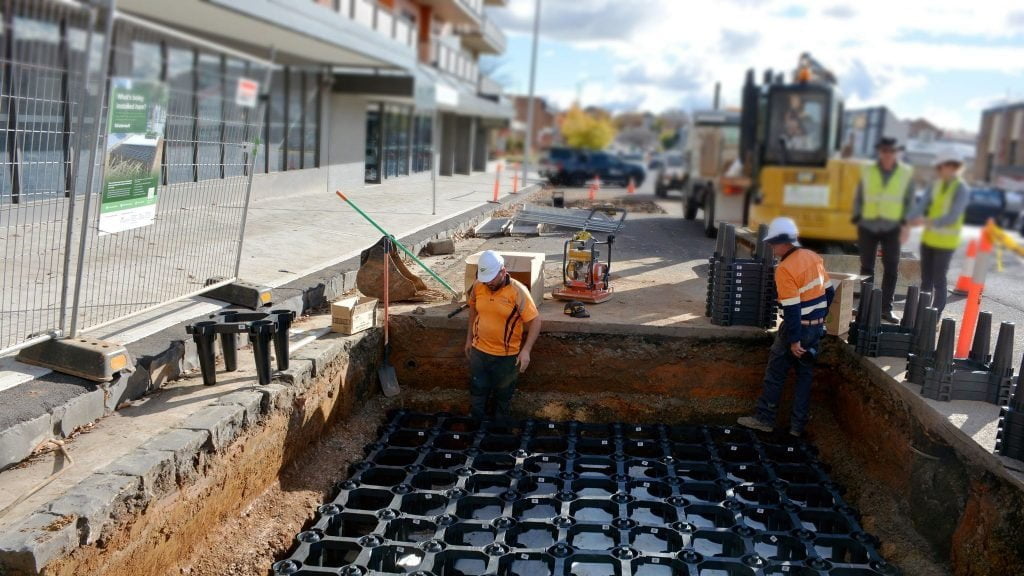
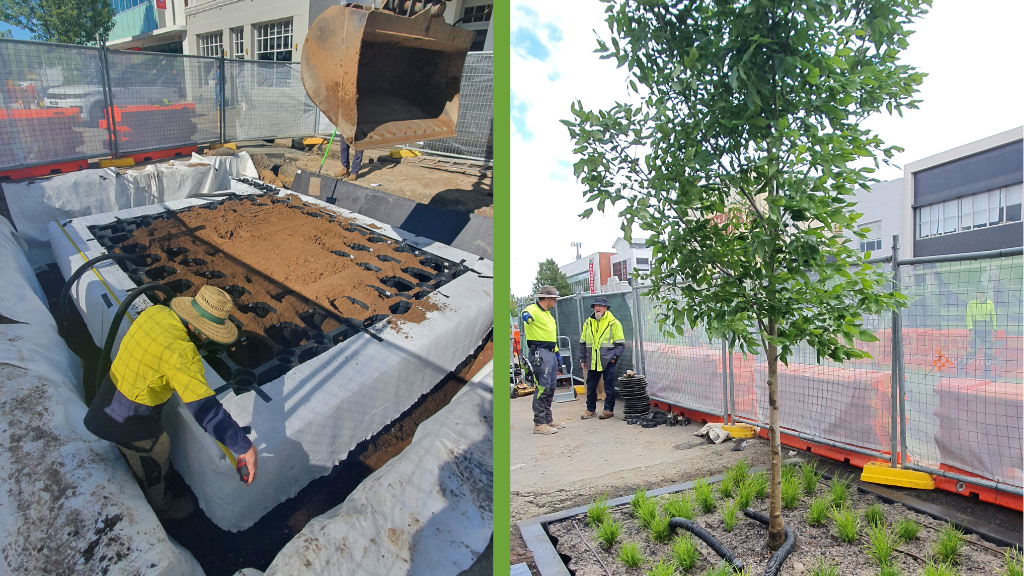
This question often comes up, in workshops we hold about the urban forest. How much soil do street trees need? Striking the right balance ensures that street trees receive adequate nutrients, space for root growth, and proper water drainage. So what aspects about soil and the underground workings of trees do we have to consider?
Tree Root Systems are Extensive
The first thing to understand is that the root system of a tree is far more extensive than many people realize. In a natural environment, the root system extends as deep as possible in the soil profile, and typically very, very broadly in the upper layer of the soil profile. Wherever there is sufficient oxygen in the soil, and friability in the soil, to support the root growth of the tree – the roots will explore.
The root plate supports the canopy – but you can’t see it
The root system of the tree provides the structural support for the above-ground canopy, which is the part that we all see. That is a very, very critical function. A tree’s canopy can be very large, is extremely heavy, and is acted upon by the forces of nature – like wind, snow, rainfall etc. Within cities, the power of wind, (sometimes known as wind tunnel effect, or canyon effect), caused by proximity to tall buildings, causes ‘wind-throw’ forces in cities to be much greater than in a forest. So a tree’s root system is critical to anchor the tree physically, and also to support the healthy growth of the above-ground canopy.
A bigger tree requires a bigger soil volume
It’s important that we understand that the amount of soil required is relative to the mature canopy size of the chosen tree species. It’s not related to the size, pot, or box that the tree was grown in at the nursery. The quantity of soil volume that you provide for a tree in the street is all the soil that that tree is going to get – for its entire life. It’s important that the right amount is provided.
Soil Volume Calculator
Try our Treepit Costing Tool to find the level of soil a tree needs to support itself once it reach maturity level.
What is a tree coffin?
Historically, trees have been planted in small openings in pavements, sometimes called tree coffins. But this has resulted in catastrophic failure in pavements, and surrounding infrastructure, premature mortality for the tree, or consigning a tree to being stunted for its life if it does live. Walk the streets of any city in the world, and you will see this. So, it’s critical that the concept of soil volume is understood, if we truly wish to grow a healthy urban forest for future generations. The surprising fact is that with the correct volumes of good quality soil – the benefits can be enjoyed within your generation. The growth rates are astounding – we just need to get the basics right.
Why is the Treepit area really important?
Tree roots will grow a long way out from the trunk. Many people have had the experience of having an underground sewer or storm pipe penetrated by a tree’s root system, and the tree was growing a long way away, in a neighbor’s property. Trees will grow a long way out from the trunk – in many cases well beyond the canopy area.
What are ‘Deep Soil Zones’?
The other thing to be understood is the fact that depth of soil is also vital to accommodate the sheer size of the tree root system. For this reason, many cities are now mandating ‘deep soil zones’ for tree planting. This is critical, and is a very good move, to ensure that there is quality soil at a suitable depth, for the life needs of the urban forest As said before, tree root systems will grow as deep as there is adequate moisture, adequate aeration, (oxygen), as well as the essential elements of healthy soil.
At Citygreen we use Snorkil™ RootRain Urban to ensure oxygen and water can easily penetrate deeper into the soil zone which encourages the tree roots to grow deeper.
How to Calculate the Volume Required for Street Trees?
To arrive at a soil volume for a street tree, one simple rule of thumb is to start with the mature canopy size of the tree. Look up reliable tree resources, investigate online, or speak to the tree nursery, and establish what the mature canopy diameter of the tree species is going to be. Generally, this is very readily available. To what width will that tree grow at its full capacity? Then you turn the diameter into the area, by using the area formula. That gives you the area of the mature canopy (shade). Then you take that area, and multiply it by 0.6x a meter, or two feet in depth, to arrive at a target soil volume. Now, this is a rule of thumb, but it’s a very good place to start. There are other, more complicated formulas – but this is a good place to start.
Another tool we use regularly is the Soil Volume Simulator designed by Elke Haege-Thorvaldson. The soil volume simulator is a great tool designed to give you a rough estimate of minimum recommended soil volume taking in consideration around tree design and height, climate growing conditions, soil suitability, maintenance programs, and expected lifespan of the tree.
You can also review Elke’s recent talk at our event ‘Where the Shade Hits the Pavement‘ where she discusses soil design for landscapes and the soil volume needed.
Finding space for deep soil zones
Rarely is there room in a sidewalk, or a parking lot, or a paved area, for the entire deep soil zone to be an open garden bed. Due to pedestrian access demands, and vehicular movements – there is a requirement for extensive use of hard pavements. The good news is, there are ways of supporting the pavement while maintaining deep soil zones beneath that pavement. But establishing a correct soil volume for street trees is the first step in establishing a healthy and sustainable urban forest, and there are several ways of arriving at target costing based upon this.
To learn more about how to design and implement a successful urban forest project, engage with an expert here.
Posted by Ben Gooden on Tue, Sep 21, 2021 @ 2:26 AM
Citygreen Projects is driven by a clear set of values, a passion for exceptional project outcomes and an enduring commitment to innovation.
What we Bring to your Urban Revitalisation Project:
Concepts and modelling
Budgeting and feasibility
Technical design and drafting
Documentation and contract admin
Project management and scheduling
Construction and quality control
Commissioning and maintenance
What is Citygreen Projects?
Citygreen Projects is your multi-disciplinary project partner to assist you in urban revitalisation projects through all phases, from conceptual modelling, budgeting, and community engagement right through to design, documentation and then final delivery of construction works.
We work together, blending our expertise and knowledge across urban planning, urban design, and landscape architecture to meet your needs and aspirations. Our advice, services and solutions are well-considered and balanced. We respond decisively to every job and every challenge, ready to help realise a successful outcome that is workable, sustainable, and achievable. We pride ourselves on integrity and commitment and believe in explaining the realities of every situation.
What Services do Citygreen Projects offer?
Citygreen Project’s role is the creation of sustainable places for people that enrich community life, provide joyful, memorable, and worthwhile experiences, and serve the natural environment.
Citygreen Projects works closely with Citygreen’s DesignStudio, a dedicated and experienced group of design professionals providing services in master planning, plans of management, design for public domain, parks and open spaces, strategy and policy for recreation, open space and public domain, and planning and design for multi-residential developments and estates.
Our process is multidisciplinary, tapping into the extensive experience and insight of experts across our practice. We take an inclusive approach, involving clients at all stages of a project to ensure their needs are met, providing education and insight wherever needed.
Who does Citygreen Projects work with?
We work with clients (particularly LGA’s) throughout Australia and New Zealand, balancing commitment, creativity, and innovation with award-winning experience. Creating great cities and places to live and work requires an ability to respond to urban and regional development complexity. Our collaborative approach integrates multiple stakeholders and complex interrelationships.
Our services extend across private and public sectors and all scales of projects, from master-planned communities to intimate and engaging interior spaces. Citygreen’s DesignStudio, a team of architects, designers, planners, engineers and environmental scientists, share the technical knowledge and the latest digital tools and resources to bring imaginative thinking to solve clients’ challenges.
Why should I use Citygreen Projects to manage my next Urban Renewal Project?
Citygreen assists you in undertaking urban landscape projects from start to finish, so you don’t have to spend the time budgeting & managing multiple contractors. At Citygreen, we have been researching and developing best practise methodologies internationally for decades to help plan, plant and maintain trees in the city and create green space in urban environments.
Citygreen Projects understands how towns, cities, and region’s function. Our aim is to work with you to make them even better, streamlining the planning and design process to ultimately deliver successful, compelling solutions.
I have a vision for an urban development project, what are the next steps?
Book a free online workshop to learn more about Citygreen Projects. This interactive workshop covers everything from creating large healthy tree canopies faster and more predictably to how to integrate living green wall systems, to incorporating stormwater management and increase the liveability and sustainability of our cities for generations to come, based on case studies, industry research, structural and civil engineering considerations.
Are you a local government council, public space architect, town planner or property developer looking to transform your local community into a vibrant green space?
This can be a great initiative to make a real difference for the health of your suburb, the local citizens and the environment. However, these projects are often costly too.
Fortunately, governments often have certain financial grants available for sustainability projects like these.
So how do you apply for a government grant successfully?
What is a government grant?
A government grant is an application for the financial assistance given by the federal, state or local government to support a particular project.
There are grants available all over the world that can help finance your plan to build sustainable spaces. However, grants are funded by tax dollars, which means strict compliances and measures must be followed to make sure that the money will benefit the whole community.
This needs to be proven for your project to even be considered.
Being approved for a government grant is a huge deal because it means that your project will be contributing to the community.
However, there are a lot of requirements and paperwork that have to be prepared and submitted in order to apply. This process can be time-consuming and quite confusing at times, due to the requirements.
How can Citygreen help you apply for a government grant?
With strict standards on product choice, support networks, procedures, costings and proposals, attaining a grant from the government can be quite a difficult task.
But we’re here to help you.
At Citygreen, we have a team of government grant application specialists who can assist you with all the paperwork and processes, from compliance to analysis, costings and more. The added benefit is that working with a known brand like Citygreen means your project will include world-renowned products with high-quality sustainability ratings.
So, you don’t just have our assistance and expertise to help you apply for the government grant, but the products and proven green systems that we include will provide a highly compelling item to your submission.
Government grand case study: working with Citygreen
Here’s an example of a client that we helped with our grant application assistance.
Both our service as well as our products successfully secured a grant from the government. This project wouldn’t have proceeded without our assistance, and we’re so proud that we were able to help facilitate such a valuable project for the good of the local community.
Citygreen is passionate about helping you achieve your goals of protecting our planet with sustainable solutions. For quality government grant application services with state-of-the-art products, contact us today!
Posted by Ben Gooden on Mon, Oct 26, 2020 @ 1:05 AM
Value and worth are two very different things – and trees are a good example of a way to demonstrate their difference.
It only costs a little to plant a tree, but the value it provides to an area is almost immeasurable.
Trees even spare cities from spending a lot of money on different services that benefit the local residents and the overall well-being of the community.
What trees contribute to a city
More than half of the global population reside in urban city areas.
To determine the contribution trees make to these areas, a study was conducted by Dr. David Nowak of the USDA Forest Service, Scott Maco of Davey Institute and their team to find out what ecosystem services trees offer.
They found that the services trees provide for these megacities are (but not limited to) producing cleaner air and water, flood control, energy efficiency, shade and noise damping.
This should come as no surprise.
However, their systematic aerial surveys of 35 megacities showed that only 20% of the average urban area is covered by forest canopy. But this varied greatly among the cities. For example, in Lima, Peru is only 1% is covered by trees, compared to New York City which was 36%.
How much money do trees really save a city?
There is quite an amount of savings to be gained when forest canopies cover urban areas.
For one, the risk of healthcare costs from air pollution is decreased, saving $0.93 million per square kilometre. In addition, around $20,000 is saved by catching water runoff. Trees also contribute to energy savings worth $478,000 for heating and cooling.
Having trees in these megacities also stores around $242 million worth of carbon dioxide.
This makes the sum of all annual savings a median value of $967,000 per square kilometre of tree cover.
The study also showed that, for every dollar invested in planting, cities see an average US$2.25 return on their investment each year.
More trees, more savings
Trees provide both short and long-term benefits for human and nature’s well-being.
What tree canopy space does your city offer?
There are many effective ways to incorporate trees into urban spaces, including sidewalks, parking lots and recreational areas. Those cities that lack space can opt for potted shrubs which offer the same benefits as trees.
Citygreen’s mission is to turn urban areas into green spaces – but we understand that it’s not always easy to do this.
Fortunately, with our selection of sustainable products and green solutions, we can make the process of growing healthy (and highly valuable) trees in cities far more efficient – helping you save more and reap the benefits.
You may not realise it, but streetscapes are a part of our daily lives and their designs play an important role in our city experience.
In fact, streetscape designs affect not only the appearance – but more importantly, the functionality of an urban environment.
For that reason, it’s crucial that streetscapes are designed with careful planning and the expertise of professionals.
The 7 important factors to great streetscape design
There are a variety of streetscapes ranging from small to large.
The larger types are often seen in areas such as parkways and highways, where their designs are more focused on vehicles. The smaller types revolve around pedestrian streetscapes.
Here are the most important things to consider when designing a streetscape:
Ease of accessibility – A great design must allow for the ease of navigation and movement to provide access to the desired location.
The separation between vehicles and pedestrians – trees, low vegetation, planters, bollards or other elements provide effective dividers for all users.
Safety – As mentioned above, having separation is crucial to offer shelter. Moreover, crosswalks and parking spaces with visible signs, proper accessible spaces and curbs are big contributors to safety as well.
Space for lounging – There must be seats where people can relax and interact along the street.
Preserve the scenery – People should be able to view buildings, businesses or points of interest from the streets. This is critical for business success, especially in retail areas.
Landscaping – A good streetscape design for pedestrians uses low landscaping at a maximum of 18-24” tall with trees maintained at 6’ or above while keeping the middle area clear. This maintains views and ensures safety.
Distinct design – A unique space can be created with materials, brick paving, signage, lighting, landscape, markings, art pieces or even with trees to provide a sense of originality.
These are just some of the many factors to keep in mind when designing streetscapes. However, this is not easy and requires the assistance of industry experts.
Citygreen aims to turn every grey space into green, one streetscape at a time.
Recently, we worked on The O’Sullivan Road Streetscape Project to build a lush, vibrant and pedestrian-focused streetscape in the heart of the Glen Waverley Activity Centre.
With Citygreen’s Stratavault product, the City of Monash was equipped with the healthiest growing and thriving trees their city has ever seen.
To help you identify the ideal option for your city, here’s a quick comparison guide about soil cells and structural soil & sand.
What is Structural Soil?
Structural soil is a commonly used soil medium for tree planting that’s compacted under a pavement system to give structural support, creating only small void spaces for tree roots to grow. It’s made up of 80% gap-graded levels (crushed stones) and 20% soil.
Structural soil, consists of crushed stones or larger objects to help provide structural stability for the above urban load such as pavements and roads. So, structural soil leaves fewer minerals, void space and nutrients available to the tree as only 20% of the available ‘soil’ is actually useable by the tree.
As a result, urban trees planted in this type of soil often experience weak roots and restricted growth due to the limited availability of nutrients and inadequate space for root expansion.
Soil cells are purpose-designed urban landscape solutions that provide trees with optimal soil conditions for growth without compromising local underground infrastructure.
Stratavault, specifically designed for easy installation and load-bearing capacity, ensures stability under pavement, parking lots, and roads while offering ample space within its interconnected matrix design for uncompacted, high-quality soil to deliver healthy tree root expansion.
The matrix also allows the integration of underground services, making it a comprehensive solution for sustainable urban development.
Stormwater can be directed into the treepit, providing on-site water supply to the tree. The tree and soil work together to naturally filter the water, removing unwanted contaminants such as road pollutants.
Example design of stormwater runoff being directed into a stratavault treepit
Any excess water can be directed to a holding vault for later use, creating a circular environment of water use (Case Study), or time-gated for release into government utilities at a later date to help with capacity during high storm level events.
This integrated approach not only promotes sustainable water management but also enhances the overall environmental resilience of the urban landscape & the targeted water also helps to accellerate tree canopy growth by feeding water directly to the tree roots.
What are the Advantages of Soil Cells Compared to Structural Soil?
The use of soil cells in urban environments offers an array of advantages, with one of the most prominent being the substantial increase in “void space” allocated for high-quality soil to support tree growth. This concept of “void space” refers to the open areas within the soil cell system.
The soil cell matrix is designed to take the above weight load of urban infrastructure such as roads, pavements, carparks, etc off the tree and soil which reduces the overall stress on the tree and soil.
As the soil vault matrix bears the weight, we can fill the void space with uncompacted high quality soil specifically tailored to meet the unique needs of the trees.
Here’s an explanation on why this increased void space is so advantageous:
Enhanced Soil Quality: Soil cells provide an opportunity to replace this subpar on-site soil with a high-quality growing medium. This soil is carefully selected or engineered to provide optimal conditions for root development, water retention, aeration and nutrient availability.
Ample Root Space: Trees need space to spread their roots to establish a stable foundation. The increased void space in soil cells allows for extensive root growth, enabling trees to access the oxygen, nutrients and water they require to thrive. Lack of soil compaction also helps accelerate tree growth as less energy is needed for tree roots to push through the soil as it explores for new sustenance. This will create healthier, resilient trees that are better equipped to withstand urban stresses.
Improved Longevity: Space is a huge complication when planning trees in urban spaces. The lack of space allocated to trees is one if the main factors in their high mortality rate in urban areas. Soil cells treepits are designed with the trees maturity in mind. This way, tree roots will have sufficient soil and space to grow for decades.
Stormwater Management: Soil cells also play a crucial role in stormwater management. The void space allows rainwater to percolate into the soil rather than becoming surface runoff. This not only replenishes the tree’s water supply but also reduces the risk of flooding and soil erosion in urban areas.
Video Comparison: Tree Growth of Structural Soil Cell vs Structural Soil Planting Methods
Below is a video from our Mill Woods parking lot case study which highlights the growth difference of trees planted at the same time.
What are the cost differences between Structural Soil and Soil Cells?
The cost difference between structural soil and soil cells can vary based on several factors, including project size, location, product choice, and installation requirements. Generally speaking, here are some key cost considerations for both options:
Structural Soil:
Structural soil involves blending soil with aggregates like crushed stone, large rocks or gravel to create a load-bearing medium.
The cost of structural soil includes soil materials, aggregates, transportation, and labor for mixing and installation.
Usage soil available to the tree is vastly lower.
Excavation and preparation of the planting area may be necessary, adding to the overall cost.
Initially, Maintenance costs are lower, but you leave yourself open to tree roots exploring and damaging surrounding infrastructure which becomes costly over the lifetime of the tree.
Soil Cells:
Soil cells are modular systems that provide high quality uncompacted soil volumes for tree roots within a matrix that can be designed to site specifications.
The cost includes the price of soil cells, soil, installation labor.
Excavation and site preparation more extensive compared to structural soil.
Lifetime cost to the tree and surrounding infrastructure is lower as tree roots are contained and reduce pavement heave.
While structural soil may seem cheaper upfront, planting a tree in a pit that isn’t right for its surroundings can lead to higher maintenance costs over time. If we don’t carefully match the tree’s needs, soil conditions, and space, its roots might struggle to grow. This can mean slow growth, a smaller canopy, and more susceptibility to pests and diseases, all requiring expensive remedies.
And that’s not all – surrounding infrastructure like sidewalks, roads, and utilities can suffer when roots can’t spread properly. This can lead to cracks, upheaval, and damage, which ends up costing more to fix than what you saved with the initial lower cost of structural soil.
Investing in systems like soil vault systems such as stratavault that support healthy root growth will pay off in the long run. These designs offer enough space for roots to access water and nutrients, promoting strong tree development. The result? Less upkeep, reduced infrastructure issues, and a longer, healthier life for the tree which will bring it’s benefits to the community quicker.
Aspect
Structural Soil
Soil Cells
Tree Growth
Stunted growth, reduced canopy development, susceptibility to pests
Robust growth, healthy canopy, improved pest resistance
Tree Health
Increased stress due to lack of soil, Vulnerability to diseases, increased need for interventions
Enhanced overall health, strong root development, reduced need for interventions
Infrastructure Impact
Upheaval of Sidewalk, road, underground utility damage due to root pressure and growth
Reduced infrastructure damage, minimized maintenance costs to city infrastructure
Maintenance Costs
Frequent pruning, fertilization, pest management, Early Replacement of trees
Lower maintenance costs, fewer interventions
Longevity
Shorter lifespan due to compromised health from lack of nutrient soil
Longer tree lifespan, sustained ecosystem benefits
Initial Savings vs. Long-Term Costs
Lower upfront cost savings overshadowed by expanded maintenance expenses
Higher upfront investment justified by long-term cost-effectiveness
Supporting Systems
Lack of proper systems to facilitate root growth and support.
WSUD systems ensure healthy root development and sustained growth
Overall Benefit to Urban Environment and Sustainability
Negatively impact urban green spaces and ecosystem services
Positively contribute to urban environment, stormwater management
The cost difference will depend on project-specific factors. It’s recommended to consult with our landscape professionals to get accurate cost estimates tailored to your project’s needs. Additionally, consider the long-term benefits of each option, such as improved tree health, stormwater management, and urban resilience, when evaluating their cost-effectiveness.
For years, Citygreen has invested in research and innovative development initiatives to explore the challenges, the causes of failure and the reasons for the premature mortality of urban trees.
Through it, we created effective soil vault systems that serve as the most viable solution to help build greener cities.
To grow large trees in urban environments presents unique challenges and considerations. Urban settings often have limited space, compacted soil, and various infrastructure constraints that hinder tree growth. However, finding effective methods for nurturing substantial trees in cities is crucial for enhancing green spaces, improving air quality, and promoting overall health and well-being for urban dwellers.
Why We Need Larger Trees in Urban Environments
From combating air pollution and mitigating the urban heat island effect to fostering biodiversity and improving physical and mental well-being, larger trees play a crucial role in enhancing the overall quality of life.
Large Trees Mitigate the Urban Heat Island Effect
Strategic placement of trees in urban areas has been proven to have a remarkable cooling effect on the shaded regions, with temperature reductions ranging between 2ºC and 8ºC. This cooling phenomenon is a result of multiple interconnected factors.
Firstly, trees provide shade through their expansive canopies, which obstruct direct sunlight from reaching the ground. By blocking the sun’s rays, trees create a cooler microclimate beneath their canopy, shielding the area from excessive heat. This is especially beneficial in densely built urban environments, where concrete and asphalt tend to absorb and radiate heat, contributing to the urban heat island effect.
Secondly, through a process called transpiration, trees release water vapor into the atmosphere. This evapotranspiration process helps dissipate heat and lowers the air temperature, further contributing to the cooling effect in the shaded areas. In addition, as water vapor is released, it can also contribute to increasing local humidity, which enhances the comfort of the surroundings.
Large Trees are Great Urban Air Filters
Large urban trees play a pivotal role in mitigating environmental pollution and enhancing air quality in urban areas. As natural filters, they possess the remarkable capacity to absorb significant amounts of air and soil pollutants, including up to 150kg of carbon dioxide (CO2), along with fine particulates
The absorption of carbon dioxide by urban trees is a crucial process in combating the escalating issue of climate change. This carbon sequestration not only helps mitigate climate change but also aids in offsetting the carbon footprint of urbanized regions, contributing to broader efforts in achieving carbon neutrality and sustainability.
The effectiveness of urban trees as pollutant filter is influenced by their proximity to emission sources. Studies have shown that trees in close proximity to pollutant-emitting activities absorb up to nine times more pollutants than trees situated farther away. So, strategic tree planting near busy roads, industrial areas, and other pollution hotspots is essential to maximize their air purification capabilities and create healthier living spaces.
The presence of large trees in urban landscapes has far-reaching effects on water bodies and the ecosystems they support.
One of the key contributions of large trees in urban settings lies in their capacity to manage and clean stormwater runoff. Impermeable surfaces like roads, pavements, and rooftops prevent rainwater from naturally infiltrating the soil. As a result, large volumes of stormwater rush over these surfaces, picking up pollutants such as oil, heavy metals, fertilizers, and other contaminants.
See how Citygreen integrate trees into the Stormwater Management process with our Strataflow System.
Large trees provide a host of physical and mental health benefits. Their presence in urban environments not only fosters cleaner air but also encourages higher levels of outdoor physical activity among nearby residents, as they create a cooler and more inviting environment for exercise
On the mental health front, spending time in the presence of large trees has been linked to reduced stress and anxiety levels. Being in nature and experiencing green spaces have a calming effect on the mind, promoting relaxation and mental rejuvenation. Moreover, large trees create aesthetically pleasing environments that positively influence mood and emotional states.
Larger Trees Improve Property Values
Larger trees significantly contribute to improving property values and are regarded as valuable assets in real estate and urban planning. The presence of well-established trees in residential neighborhoods and commercial areas adds a touch of natural beauty, reduce noise pollution, decrease crime rates, and reduce power usage due to temperate reductions. Another study also showed that, for every dollar invested in planting, cities see an average US$2.25 return on their investment each year.
So, the faster tree canopies grow, the sooner the benefits can be enjoyed by cities, stakeholders and communities.
How to Plant Large Trees in an Urban Environment
Planting large trees in an urban environment requires careful planning and the implementation of effective strategies to ensure the successful establishment and long-term growth of the tree. Utilizing advanced urban forestry practices and harnessing the potential of technology like Citygreen’s Stratavault soil vault system can significantly enhance the viability and sustainability of urban tree planting.
Another crucial aspect is the preparation of the planting site. Urban soils are often highly compacted due to the need to support surround infrastructure such as pavement, roads and building foundation. Highly compacted soil is not conducive to tree growth as the soil is and lacking in nutrients, oxygen and space for growth which hinders root development .
When growing large trees in urban environments, Citygreen’s Stratavault soil vault product proves to be a game-changer when it comes to urban tree planting. Its modular design allows for efficient and scalable tree planting in confined urban spaces. The stratavault system creates an ample underground soil volume, providing ample room for root expansion and nutrient uptake while ensuring the roots are contained within the matrix and never impact surrounding infrastructure like roads pavements, and underground utilities. This innovative technology also facilitates stormwater management, reducing runoff, stormwater capture and storage while enhancing the tree’s access to water, ensuring its resilience during dry periods.
Another consideration when planting large trees in urban areas is the selection of suitable tree species. Opting for native or adaptive tree species that are well-suited to the local climate, soil conditions, and urban challenges is crucial. These species exhibit greater resilience to local environmental stressors, making them more likely to thrive in the often harsh urban settings.
Urban Tree Growth Case Study
At Citygreen, we love science. Since 2011, we’ve researched, developed and refined our range of sustainable urban landscape solutions to withstand rigorous testing – and produce outstanding results. So, when our Stratacell structural soil vault system became the subject of a study comparing the performance of soil treatments under concrete paving, we were keen to see the findings.
The study, entitled ‘Comparison of Soil Treatments Under Concrete Pavement’ was conducted by Thomas Smiley, James Urban and Kelby Fite at the Bartlett Tree Research Laboratory in Charlotte, North Carolina. It examined variations of the two main approaches that have been developed to provide rooting space for trees in urban areas – supported pavement and structural growing media.
Overall, the study found that structural https://citygreen.com/understanding-the-importance-of-tree-canopy/load bearing modules (like Citygreen Stratacell and Stratavault systems) grow the largest, healthiest trees in the fastest time. It also highlighted the superior all-round performance of these systems compared to others.
Study goals
The purpose of the study was to compare the growth of trees in different supported pavements and structural growing media. The aim was to determine which methodology would produce the largest, healthiest trees in the shortest time.
Combats climate change by reducing greenhouse gas emissions
Provides natural shade and cooling
Conserves energy and reduces power costs
Enables water filtration and retention
Provides habitats for wildlife
Increases property and area values
Promotes health and wellbeing
Contributes to a sense of place
Encourages community interactions
SUP Trial Plot Sept 2017
Methodology
To achieve the study goals, two plots were established at the Bartlett Tree Research Laboratory. The first plot was installed in 2004, exclusively for Study 1, which examined five variations of supported pavement systems. The second plot was established in 2014, specifically for Study 2, which examined six variations of structural media.
Citygreen’s Stratacell system was part of Study 2, which also included an open control, compacted control, sand based structural soil (SBSS), gravel based structural soil (GBSS) and another structural load bearing module, similar to Stratacell.
At the start of Study 2, on 19 August 2014, containerised 18mm caliper Liriodendron chinense trees were installed in the centre of each plot. A 5cm thick layer of concrete was poured over the plot, with a 20cm hole centred on each tree. A soil moisture sensor was also fitted.
Over the following three years, the trees were measured and assessed regularly against key performance indicators. On 23 October 2017, the trees were severed at the root for final measurements and findings. During the excavation, soil was removed from the roots, leaving the mass intact for examination.
Pressure wash and Hydrovac for removal of soil from the root systems
Airspade removing soil from around the roots
Weighing Process of all root systems
How to Grow Large Trees in Urban Environments Key Findings
Overall, the study found that soil treatments that provided a low density growing media aka uncompacted soil (such as Citygreen Stratacell and Stratavault) resulted in the largest, healthiest trees in the shortest time. These findings were consistent across Study 1 and Study 2. However, in Study 2, the tree growth differences between the systems were more pronounced than in Study 1.
The structural load bearing systems, including Stratacell, performed extremely well in Study 2. Compared to the compacted soil, SBSS and GBSS, these systems consistently achieved the highest scores across multiple measures of tree health and growth, including:
Tree trunk diameter
Tree height
Foliar Colour
Number of roots > 1.2cm diameter
Maximum root spread
Maximum root depth
Weight of tree parts
Moisture content of soil
Stratacell outperformed all other systems in terms of maximum root depth, moisture content and foliar colour. Like the other structural load bearing module, it also produced significantly larger trees with more large roots than other treatments, including compacted soil, SBSS and GBSS.
The final findings were consistent with observations throughout the study, which reported that the trees in structural load bearing modules began to diverge from other treatments by the end of 2015. Similarly, in 2016 and 2017, there were significantly larger than most other treatments.
Trees grown in structural load bearing modules
Tree roots developed in Stratacell and Silvacell vault systems
Root systems grown in gravel based Structural Soil
Green space for shading and mitigation of heat island effect
Providing soil volumes in urban spaces
Conclusion
The study concluded that structural soil vault modules (such as Citygreen Stratacell and Stratavault) are superior for growing large, healthy trees in the fastest times when compared to other systems, such as compacted soil, SBSS and GBSS.
While the study did not point to a ‘best product’, it proved the methods that support the load on a pavement and keep that load off the growing media work better than those that don’t.
This is good news for urban planners, landscape gardeners, architects and developers. It means that, simply by choosing a structural load bearing soil system, they can achieve the canopy cover they require years sooner than they might with other systems.
Similarly, cities, communities and individuals can enjoy the environmental, economic and health benefits of tree canopies faster and for longer.
Have one of the Citygreen contact you.
Contact the friendly Citygreen Team now for more information by clicking here.
Download the full report
Click here to download the full ‘Comparisons of Soil Treatments Under Concrete Pavement’ study.
Posted by Ben Gooden on Mon, Jul 10, 2017 @ 5:05 AM
What are Soil Vaults and How Do they Benefit City Trees?
Soil vaults like Citygreen’s Stratavault are underground structures that provide a natural rooting environment for trees in urban areas where soil is often compacted to handle the stress and weight of the above urban infrastructure. They are a modular matrix designed to support all of the tree’s mineral, nutrient, and root spaces requirements ensuring ideal underground growth conditions, while taking the weight of the above infrastructure off from the tree.
Are Soil Vaults a Cost-Effective Solution for Urban Landscaping?”
Yes, soil vaults can be considered a cost-effective solution for urban landscaping in the long run. While the initial investment in installing soil vaults may be higher compared to traditional methods, their long-term benefits often outweigh the upfront costs.
Here’s why soil vaults can be cost-effective:
Reduced Tree Replacement Costs: Soil vaults provide an optimal environment for tree root growth, leading to healthier and more resilient trees. This reduces the need for frequent tree replacements, which can be expensive in terms of tree purchase, planting, and labor.
Enhanced Tree Growth: Soil vaults offer trees the necessary space, nutrients, and oxygen for robust growth. Well-established trees require less maintenance over time, leading to lower ongoing maintenance costs.
Prevention of Infrastructure Damage: Urban trees with strong root systems supported by soil vaults are less likely to disrupt sidewalks, roads, and other infrastructure, reducing the need for costly repairs.
Environmental Benefits: Healthy trees provide various environmental advantages, such as improved air quality, reduced energy costs through shading, and stormwater management. These benefits can lead to long-term savings for municipalities and property owners.
Increased Property Value: Green spaces and healthy trees contribute to the aesthetic appeal of urban areas, increasing property values and attracting businesses and residents. This positive economic impact can indirectly contribute to the cost-effectiveness of soil vaults.
While soil vaults may have higher initial installation costs, their ability to accelerate healthy tree growth, minimize maintenance, prevent infrastructure damage, and provide numerous environmental and economic benefits make them a viable long-term investment for urban landscaping projects, and this is where having a asset register of your trees is invaluable to seeing the lifetime value green infrastructure can have.
All city councils have an asset register detailing the value of assets like roads, parks, street furniture, and so on. Increasingly – and rightly so – trees are now being included as quantifiable assets. In the past, it has been hard to quantify the value of trees, but today there are a number of methodologies for doing so. One such method, the Burnley Method – developed by Dr Greg Moore at the Victorian College of Agriculture and Horticulture Limited, Burnley Campus – is now being widely used and accepted. Available for download here.
The Burnley Method For Valuing Trees
The Burnley Method is a way to determine the value of trees in a straightforward manner. It involves looking at different aspects of a tree, such as its type, size, health, and where it’s located. By considering these factors, we can figure out how valuable the tree is both in terms of its natural qualities and its surroundings. The Burnley Method helps provide a clear and organized approach to assessing the worth of trees.
Formula:
VALUE ($) = TREE VOLUME x BASE VALUE x (E) x (V) x (FV) x (L)
The modifiers to be used are:
TREE SIZE (V) : With large trees, the values determined by the formula were unrealistically high. Accordingly, a modifier was developed (Table 1) to reduce the value.
USEFUL LIFE EXPECTANCY (E) : This modifier took into account the projected useful life expectancy of the specimen (Table 2).
FORM AND VIGOUR (FV) : This factor was used to assess the form and vigour of the tree (Table 3)
LOCATION (L) : This modifier was used to assess the tree’s suitability for its particular location (Table 4).
The City of Melbourne are pioneers in valuing their trees and looking after them accordingly. In fact, residents can even email local trees to raise concerns about their health or express their appreciation and affection for the tree. By putting a value on trees, councils are able to protect them in new and quantifiable ways.
For example, if a developer is building near a valuable tree, the council may require them to pay a bond – refunded provided the tree is unharmed post construction. If a developer destroys or removes a tree without permission, the council is able to sue that developer for the value of the tree per their register. All of this is effective and much-needed motivation to keep our valuable urban trees safe.
A council’s asset register forms a key part of their balance sheet. As the assets degrade over time, there is depreciation. Spend money on their assets, and there is growth. Naturally, councils want to spend money wisely in order to generate the greatest return on investment.
In an asphalt carpark next to an oval, five London Plane trees were planted in quite narrow islands, with adequate space and soil volume provided using the Stratacell system beneath the carpark pavement. The cost for the five trees (including the Stratacell soil vault system) was $50,000 at time of initial planting.
Four years later, as reported by Council, the trees have grown at an unprecedented rate – from a 75mm/3” trunk diameter at time of planting, to 250mm/10”. According to the Burnley method, these trees are valued by Council at $17,500 each – an amazing return on investment in just four years, with so much growth (literally and financially) still to come.
As a comparison, the same council planted the same species 15 years ago in a nearby carpark using the conventional method. The carpark was laid, a square cut in the pavement, some curbing placed around the edges, road base dug out, and a 80/20 structural soil loaded into the hole.
Planted 15 years ago (versus only four), these trees are valued at only $510 each. Of course, the initial outlay was much less ($250 per tree), but the return on investment monetarily, aesthetically and environmentally does not compare.
Essentially, using the Citygreen soil vault system, this innovative Council was able to grow trees worth 34 times as much – in one quarter of the time!. As more emphasis is placed on generating ROI in relation to the value of trees, adopting innovative technology which enables trees to thrive in urban environments must be a priority.
Of course, this is not just about improving councils’ bottom lines, but also improving the health and wellbeing of the communities they serve.
Speak to our team to explore how soil vaults can maximise the value of your trees and generate an ROI faster.
“Great customer service, quick response times and a very in depth QA system with constant support.”
- Laura Wiesenekker, Project Engineer, Densford Civil -
“Citygreen is a very professional business, and I found everything was great in terms of deliveries, product supply and information. It was all forthcoming and helped us to complete the project.”
- Keith Burns, Architect/Designer, Keith Burns Architect -
“Citygreen offered training and invaluable technical assistance during the works.”
- James Callan, Estimating Manager, Complex Co Pty Ltd -
“Our experience, in working with a Citygreen Design Studio was second to none. We found responses from the design studio to be very timely, and technically thorough. We went backwards and forwards a number of times, looking at different iterations of the design and, nothing was too much trouble to examine and explore different possibilities. I would highly recommend the Citygreen Design Studio to any future client considering using your services.”
- Sandra Smith, Principal Landscape Architect, City Of Monash -
“We are big on compliance on all projects, and the fact that their SmartCertify cloud platform covers all bases, and supports their 20 year warranties, is critical – especially that these pits are being installed under roadways and footpaths.”
- Johny Purkaystha, Civil Program Engineer, Central Coast Council -
"I reviewed all the previous projects that we have installed in the past couple years using your product and I can happily report back that we have 0% mortality in the soil cells, which is incredible!"
- Brendan Wilton, CEO, Trim Landscaping, Bedford, Canada -