City interchange in xian, road junction at dusk, China
From widening wealth disparity to the environmental ramifications of economic development—the growing focus on global sustainability is a clear sign of the times.
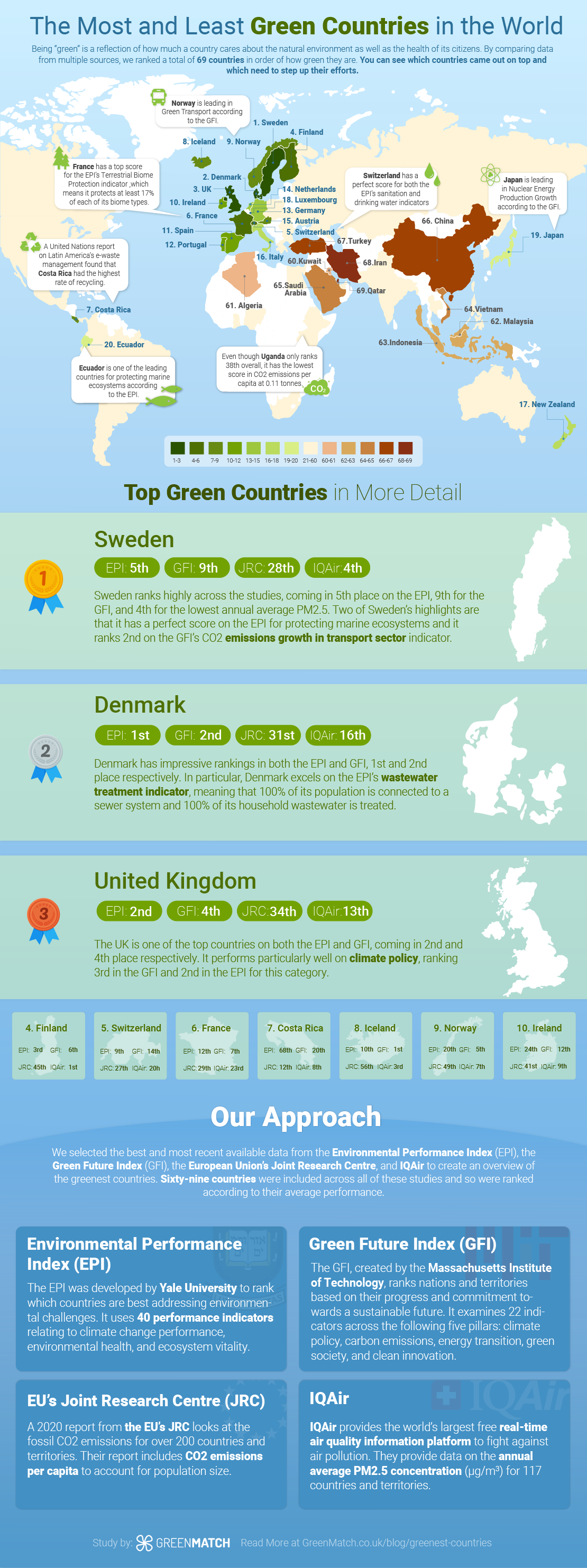
Research reveals that when a sustainable ethos is applied to policy and business, it typically bodes well for economies and people alike. By providing benchmarks for those decisions, indexes like Yale’s Environmental Performance Index (EPI) can be critical to measuring national sustainability efforts.
Who’s the Greenest of them All in 2023?
Despite the decades-long trend of globalization, national environmental policies have proved to be widely divergent. The EPI report confirms that those policies—and their positive results—are highly correlated with national wealth.
This is evidenced in the global EPI distributions, seen below:
OVERALL RANK
COUNTRY
SCORE
REGIONAL RANK
1
Sweden
82.5
1
2
Denmark
82.3
2
3
United Kingdon
81.5
3
4
Finland
81.3
4
5
Switzerland
80
5
6
France
79.6
6
7
Costa Rica
78.9
7
8
Iceland
78.7
8
9
Norway
77.7
9
10
Ireland
77.2
10
Scandinavian countries, which tend to have a high GDP per capita, show strong and consistent results across EPI parameters. Denmark for instance—which ranks first overall—leads the world in slowing its growth in CO2 emissions. Meanwhile, neighbour Sweden leads in landfill and recycling treatment, while wastewater treatment is led by a handful of countries within and beyond Scandinavia including Denmark, Finland, the Netherlands, Singapore, and Sweden.
In North America, Canada claims the top spot in the biodiversity and habitat category, while the U.S. ranks sixth in agricultural diversity globally. In Asia, Singapore leads the world in fishery health and sustainability.
Ultimately, it appears the world’s greenest countries tend to focus on all areas of sustainability, while laggard countries show more uneven performance across categories.
What Does “Green” Mean?
Each high-level performance indicator with the EPI, like “environmental health”, is broken into subsections. Nations are scored on each subsector on a scale up to 100. As a result, multiple countries can rank first in any given category.
By evaluating national sustainability on a scale that is unrelated to other nations, we get a clearer idea of comparative national progress, beyond a basic ranking.
For instance, 30 countries tie for first in marine protection, all with scores of 100. This shows that many economies are prioritizing this area of sustainability.
The Cost of Being Green
Infrastructure costs are one reason why wealthier nations tend to fare better across sustainability measures. Everything from air pollution reduction and water treatment, to hazardous waste control and mitigation of public health crises, are especially expensive—but have a huge potential impact on citizens.
This trend can be seen in the scatterplot, which demonstrates the distribution of economies evaluated by the EPI.
Post-Pandemic Outlook
Although some rankings can seem prosaic, indexes like the EPI provide a helpful benchmark for economies to compare efforts. It also allows governments to iterate and build upon environmental strategies and investments by highlighting what is and isn’t working.
CO2 emissions, for instance, are a major driver of climate change. Although the global economic stall has led to a temporary dip in CO2 emissions in early 2020 (a slower growth rate than the 11% expected to rise), global emissions still continue.
However, the EPI shows that investments have an impact. High-level sustainability efforts—political commitment, media coverage, regulations—can deliver results, even at the grassroots level.
Cora Lynn Falls next to a man fern (aka soft tree fern, Dicksonia antarctica) in the Great Otway National Park, Victoria, Australia.
In the land Down Under, we’re currently in the thick of a long, hot summer. Most of us spend our spare time during this season at the beach. But, what if there was another destination that offered even greater relaxation? Somewhere less busy, searing, and sandy? Somewhere green, of course. Australia, we’re lucky to have more than 500 national parks –wild, rejuvenating, and free for all.
Lord knows we need a little relaxation. According to an Australian Bureau of Statistics survey completed in 2007, one in five Australians experiences a mental disorder each year. Most common are anxiety disorders, like obsessive-compulsive disorder, social anxiety, or panic disorder.
Thankfully, there is a relatively simple salve with more than 40 years of research showing that exposure to nature increases calm, decreases agitation, and improves concentration and creative thought. Writer and I Quit Sugardynamo, Sarah Wilson, is renowned for her solo hikes–jumping on a train to a national park somewhere out of town and disappearing into the wild for days at a time. She says she returns settled, sated, and full of creative ideas.
Of course, when we’re not on holidays, it’s not always possible to plant ourselves in a national park. In this sense, urban greenery is more important than ever before.
Zoe Myers, an Urban Design Specialist at the University of Western Australia, says research shows those city dwellers have a 20% higher chance of suffering anxiety and an almost 40% higher chance of developing depression. Fortunately, research also shows that people in urban areas who live closest to the greatest green space are much less likely to suffer poor mental health.
Otway National Park, Victoria
The benefits of urban greening are endless –cooler cities in summer, warmer cities in winter, slower stormwater runoff, filtering of air pollution, habitat for animals, happier people, and more prosperous local economies. If you can, take a trip to a national park and soak in the natural goodness. But, when you’re back at work, don’t forget to take lunch in the park–toes in the grass, breeze in your hair, eyes on the branches above.
The City of Cockburn, located in dry, hot Perth, Western Australia, is prioritising urban forestry by aiming to plant 15,000 street trees in its suburbs within the next 10years. Recent statistics showed that Cockburn’s existing green cover is just 26%, with almost 90% of that located in environmental reserves, parks and ovals. That makes for some very bare streetscapes!
Increasing the street tree canopy is an opportunity to reduce the heat island effect across the City
Urban forest coverage in the City of Cockburn
As part of the City’s Urban Forest Plan 2018-2028, residents can request a free street tree to increase the shade canopy in their street. Cockburn Parks and Environment Manager, Anton Lees, said the City had budgeted $300,000 for the program to increase their street tree tally to more than 53,000.
Lees said, “During the past decade the City of Cockburn has experienced rapid clearing of vegetation due to urban development. In a recent national survey on the state of vegetation cover in metropolitan Australia, Cockburn has ranked in the lowest quartile of the 140 local authorities studied for the degree to which they had lost shade canopy.
Urban heat surface temperature on 42-degree day
“The city must improve its shade canopy and the Urban Forest Plan will help balance urban expansion with a comprehensive program to maintain and protect the existing tree canopy, while expanding it in the future. A thriving urban forest has a multitude of benefits including lowering maximum summer temperatures in urban areas, reducing household energy costs and according to University of WA research, increasing property values by up to $17,000.”
We look forward to seeing a green transformation in Cockburn in the coming years!
Source: https://www.communitynews.com.au/cockburn-gazette/news/city-of-cockburn-aims-for-15000-more-street-trees/
Image credit: City of Cockburn, Street tree master plan
Posted by Ben Gooden on Wed, Nov 11, 2020 @ 2:49 AM
Vehicles play an essential role in today’s cities and growing nations.
For most urban cities, vehicles are an indication of a progressive economy. Cars, trucks and buses provide access to businesses through people and product transport. However, the drawback is that these same city streets have become grey places where vehicles are prioritized over people in the way we design cities.
While busy roadways deliver unmistakable benefits, they don’t entirely enhance citizen welfare and overall human wellness within anurban landscape. Cars require significant space to drive and park – space that significantly reduces the opportunities for residents to walk freely, appreciate nature and enjoy outdoor activities. This is without even mentioning traffic, pollution and safety issues.
The revolutionary Woonerf design solves this problem by transforming trees found within urban environments into shared green spaces where pedestrians and vehicles can actually co-exist in an optimal balance.
Through it, you can improve the local community’s quality of living and heighten road safety in the city.
What is a “Woonerf”?
A Dutch term meaning “living street” or “shared space,” refers to a design concept aimed at creating a safer, more interactive, and pedestrian-friendly environment within urban areas.
In a woonerf, vehicles, pedestrians, and cyclists share the same space, with an emphasis on reducing vehicle traffic and creating a safer atmosphere by encouraging social interaction, enhancing walkability, and promoting a sense of community while prioritizing the well-being and safety of pedestrians and cyclists.
This street design modelled around shared space, low-speed limits and traffic calming was first implemented in the Netherlands and Belgium.
A Woonerf design places emphasis on the overall quality of life, rather than the speed of it. Traffic calming strategies such as street furniture, increased trees and plants, bollards, limited sight distance and narrow paths of travel are utilised to lessen car traffic, offering residents a greater sense of ease, safety and comfort when walking city streets.
By using Woonerf techniques, urban streets are transformed to a social space where pedestrians are encouraged to make use of the entire roadway, move freely from one point to another and participate in recreational activities and increase patronage to businesses.
A Woonerf-designed street creates no division between vehicles and people. Hence, it is referred to as a “shared space” that is open for cars but is also catered to giving citizens a pedestrian-friendly and welcoming environment.
One characteristic feature of Woonerf is landscaping. Through community gardens, plant boxes and thriving city trees, people have a better city experience due to the calming and inviting natural elements that create a more pleasant ambiance, encourage pedestrian interaction, and prioritize the well-being of individuals over vehicular traffic when travelling through their local city streets.
Let’s demonstrate this with a practical example.
A Real Woonerf case-study: John Hirsch Place in Winnipeg, Canada
Before the City of Winnipeg decided to revamp John Hirsch Place, it was simply a one-way road with sidewalks on either side and parking spaces along the edge of the street.
With the path hindered by garbage bins, fences and trees, John Hirsch Place was not very welcoming and accessible for citizens. The vehicle-centric road also didn’t feature pedestrian amenities that encouraged residents to the street.
Fortunately, the City of Winnipeg’s Transportation Master Plan addressed these concerns by enhancing the downtown’s street to become safer, greener and most importantly, accessible and equitable to all road users – including pedestrians.
The Woonerf model was then implemented at John Hirsch Place to reduce traffic on the residential road, increase road safety and position the idea of the street as a public open space where people could move freely from connected pathways, parking lots and buildings.
Today, the new roadway hosts a new layout without the traditional curb, sidewalk and boulevard set-up, but instead, with installed bollards to guide car traffic and give residents enough protection against vehicles – allowing them to co-exist safely in the city street. Another part of the Woonerf design you can see at John Hirsch Place is the significant lighting that encourages pedestrian activity even in the evening.
How to Plant Trees in a Woonerf Designed Street
For the landscaping aspect of this Woonerf approach, Citygreen’s soil vault system is the ideal choice. It facilitates the healthy growth of trees and shrubs at John Hirsch Place by offering a structural strength matrix as a sub-base for the roadway.
Citygreen’s Stratavault soil vault system helps trees grow in densely built urban areas, similar to a Woonerf approach. It achieves this by providing a large volume of soil to the trees through a structural matrix installed beneath the pavement or road, allowing their roots to thrive when compared to traditional tree planting methods.
The key advantage of a soil vault system is its ability to support the weight of the pavement or road above, while also ensuring ample space for the tree roots to grow.
Moreover, the soil vault system can effectively integrate stormwater management principles into its design. The key way the stratavault soil vault system can improve stormwater management principles include:
Stormwater Filtration: As stormwater filtrates into the vault, pollutants and sediments get filtered out by the tree roots and high quality soil. This process improves the water quality of the excess stormwater and reduces the negative impact of runoff on downstream ecosystems.
Peak Flow Reduction: During intense rain events, the peak flow of stormwater can put a strain on existing stormwater infrastructure and exacerbate flooding issues. Soil vaults help mitigate this problem by attenuating the flow rate. By slowing down the release of water, the system eases the burden on downstream drainage systems and helps prevent erosion.
The Role of Citygreen’s Soil Vault Solution in a Woonerf Design
The City of Winnipeg decided to utilise Citygreen’s soil cell solution due to the space constraints found within this particular urban environment. This soil retention system enables trees and shrubs in this Woonerf case study to have sufficient soil volume for their growth and development while maximising the available right-of-way for all road users.
The system also provides a stormwater management advantage for John Hirsch Place. Since Downtown Winnipeg is composed of old, combined sewer systems that already required maintenance, repair or replacement, the soil cell system was used to reduce the flow and loading within the aging combined sewer network.
The application of Citygreen’s soil vault solution for the Woonerf model utilised at John Hirsch Place has already supported the growth of approximately 600 perennials and 20 new and mature trees. This has led to an improved public right of way that has also cultivated a greener shared urban space for both vehicles and residents.
The Woonerf approach to city planning is blazing new trails in improving the quality of life in residential streets all across the world.
Citygreen, with its cutting-edge technology and urban landscape solutions, can help take the Woonerf model to a new level. Through innovative soil vault systems, improving pedestrian environments, addressing concerns about vehicle movements and enhancing streetscape can be achieved with a greener and more cost-effective way.
Are you a local government council, public space architect, town planner or property developer looking to transform your local community into a vibrant green space?
This can be a great initiative to make a real difference for the health of your suburb, the local citizens and the environment. However, these projects are often costly too.
Fortunately, governments often have certain financial grants available for sustainability projects like these.
So how do you apply for a government grant successfully?
What is a government grant?
A government grant is an application for the financial assistance given by the federal, state or local government to support a particular project.
There are grants available all over the world that can help finance your plan to build sustainable spaces. However, grants are funded by tax dollars, which means strict compliances and measures must be followed to make sure that the money will benefit the whole community.
This needs to be proven for your project to even be considered.
Being approved for a government grant is a huge deal because it means that your project will be contributing to the community.
However, there are a lot of requirements and paperwork that have to be prepared and submitted in order to apply. This process can be time-consuming and quite confusing at times, due to the requirements.
How can Citygreen help you apply for a government grant?
With strict standards on product choice, support networks, procedures, costings and proposals, attaining a grant from the government can be quite a difficult task.
But we’re here to help you.
At Citygreen, we have a team of government grant application specialists who can assist you with all the paperwork and processes, from compliance to analysis, costings and more. The added benefit is that working with a known brand like Citygreen means your project will include world-renowned products with high-quality sustainability ratings.
So, you don’t just have our assistance and expertise to help you apply for the government grant, but the products and proven green systems that we include will provide a highly compelling item to your submission.
Government grand case study: working with Citygreen
Here’s an example of a client that we helped with our grant application assistance.
Both our service as well as our products successfully secured a grant from the government. This project wouldn’t have proceeded without our assistance, and we’re so proud that we were able to help facilitate such a valuable project for the good of the local community.
Citygreen is passionate about helping you achieve your goals of protecting our planet with sustainable solutions. For quality government grant application services with state-of-the-art products, contact us today!
Posted by Ben Gooden on Mon, Oct 26, 2020 @ 1:05 AM
Value and worth are two very different things – and trees are a good example of a way to demonstrate their difference.
It only costs a little to plant a tree, but the value it provides to an area is almost immeasurable.
Trees even spare cities from spending a lot of money on different services that benefit the local residents and the overall well-being of the community.
What trees contribute to a city
More than half of the global population reside in urban city areas.
To determine the contribution trees make to these areas, a study was conducted by Dr. David Nowak of the USDA Forest Service, Scott Maco of Davey Institute and their team to find out what ecosystem services trees offer.
They found that the services trees provide for these megacities are (but not limited to) producing cleaner air and water, flood control, energy efficiency, shade and noise damping.
This should come as no surprise.
However, their systematic aerial surveys of 35 megacities showed that only 20% of the average urban area is covered by forest canopy. But this varied greatly among the cities. For example, in Lima, Peru is only 1% is covered by trees, compared to New York City which was 36%.
How much money do trees really save a city?
There is quite an amount of savings to be gained when forest canopies cover urban areas.
For one, the risk of healthcare costs from air pollution is decreased, saving $0.93 million per square kilometre. In addition, around $20,000 is saved by catching water runoff. Trees also contribute to energy savings worth $478,000 for heating and cooling.
Having trees in these megacities also stores around $242 million worth of carbon dioxide.
This makes the sum of all annual savings a median value of $967,000 per square kilometre of tree cover.
The study also showed that, for every dollar invested in planting, cities see an average US$2.25 return on their investment each year.
More trees, more savings
Trees provide both short and long-term benefits for human and nature’s well-being.
What tree canopy space does your city offer?
There are many effective ways to incorporate trees into urban spaces, including sidewalks, parking lots and recreational areas. Those cities that lack space can opt for potted shrubs which offer the same benefits as trees.
Citygreen’s mission is to turn urban areas into green spaces – but we understand that it’s not always easy to do this.
Fortunately, with our selection of sustainable products and green solutions, we can make the process of growing healthy (and highly valuable) trees in cities far more efficient – helping you save more and reap the benefits.
You may not realise it, but streetscapes are a part of our daily lives and their designs play an important role in our city experience.
In fact, streetscape designs affect not only the appearance – but more importantly, the functionality of an urban environment.
For that reason, it’s crucial that streetscapes are designed with careful planning and the expertise of professionals.
The 7 important factors to great streetscape design
There are a variety of streetscapes ranging from small to large.
The larger types are often seen in areas such as parkways and highways, where their designs are more focused on vehicles. The smaller types revolve around pedestrian streetscapes.
Here are the most important things to consider when designing a streetscape:
Ease of accessibility – A great design must allow for the ease of navigation and movement to provide access to the desired location.
The separation between vehicles and pedestrians – trees, low vegetation, planters, bollards or other elements provide effective dividers for all users.
Safety – As mentioned above, having separation is crucial to offer shelter. Moreover, crosswalks and parking spaces with visible signs, proper accessible spaces and curbs are big contributors to safety as well.
Space for lounging – There must be seats where people can relax and interact along the street.
Preserve the scenery – People should be able to view buildings, businesses or points of interest from the streets. This is critical for business success, especially in retail areas.
Landscaping – A good streetscape design for pedestrians uses low landscaping at a maximum of 18-24” tall with trees maintained at 6’ or above while keeping the middle area clear. This maintains views and ensures safety.
Distinct design – A unique space can be created with materials, brick paving, signage, lighting, landscape, markings, art pieces or even with trees to provide a sense of originality.
These are just some of the many factors to keep in mind when designing streetscapes. However, this is not easy and requires the assistance of industry experts.
Citygreen aims to turn every grey space into green, one streetscape at a time.
Recently, we worked on The O’Sullivan Road Streetscape Project to build a lush, vibrant and pedestrian-focused streetscape in the heart of the Glen Waverley Activity Centre.
With Citygreen’s Stratavault product, the City of Monash was equipped with the healthiest growing and thriving trees their city has ever seen.
California is known for many things–Disneyland, Hollywood, its beaches and more. But now more than ever, with the frequency of wildfires in the state, it seems that people cannot avoid mentioning the fires when the topic of California comes up. They’ve gotten so frequent that Californians residents are no longer surprised when a fire sweeps through. Can something be done?
California’s yearly fire season
California’s fire season has gotten worse over the years –lasting longer and becoming more destructive. Compared to the prior decades, the fire-affected zone has doubled every year since the year 2000. Unfortunately, it’s believed that this will only worsen over time. After more than a century of suppressing these fires, Californian forests are now overgrown, and this poses even more of a danger. Some parts of the land hold three to five times as many trees compared to previous years. Now that they are crowded into a small space, trees have also grown weak as they compete for water, nutrients and sunlight. On top of that, shrubs and small plants tend to multiply in wet weather, increasing the risk of kindling once dried.
How can this be prevented?
You may think that there is no solution -but some smart tactics can actually be implemented to help limit these forest fires. These tactics aim to restore the forests back to healthy, historic conditions where the trees were widely spaced apart from each other with diverse native grasses and wildflowers growing below. These techniques are often referred to as climate-smart or holistic forest restoration. The most critical thing to do now is to bring back vitality to the forests. Thinning overgrown trees and leaving the largest and most flame-resistant trees can help the land survive the unpredictable climate. With empty spaces left behind by strong flames, new seedlings can be hand-planted at more of a distance apart to prevent the widespread of fire in the future.
It’s only a matter of time before these vast forests become natural casualties to the dreaded California wildfires-so it is important that we do whatever we can to help counteract these catastrophes. At Citygreen, our vision revolves around turning the world into an effective green space where all mankind can sustainably benefit from its natural resources. That’s why we align our products and solutions towards building and nurturing a healthy environment.
“Great customer service, quick response times and a very in depth QA system with constant support.”
- Laura Wiesenekker, Project Engineer, Densford Civil -
“Citygreen is a very professional business, and I found everything was great in terms of deliveries, product supply and information. It was all forthcoming and helped us to complete the project.”
- Keith Burns, Architect/Designer, Keith Burns Architect -
“Citygreen offered training and invaluable technical assistance during the works.”
- James Callan, Estimating Manager, Complex Co Pty Ltd -
“Our experience, in working with a Citygreen Design Studio was second to none. We found responses from the design studio to be very timely, and technically thorough. We went backwards and forwards a number of times, looking at different iterations of the design and, nothing was too much trouble to examine and explore different possibilities. I would highly recommend the Citygreen Design Studio to any future client considering using your services.”
- Sandra Smith, Principal Landscape Architect, City Of Monash -
“We are big on compliance on all projects, and the fact that their SmartCertify cloud platform covers all bases, and supports their 20 year warranties, is critical – especially that these pits are being installed under roadways and footpaths.”
- Johny Purkaystha, Civil Program Engineer, Central Coast Council -
"I reviewed all the previous projects that we have installed in the past couple years using your product and I can happily report back that we have 0% mortality in the soil cells, which is incredible!"
- Brendan Wilton, CEO, Trim Landscaping, Bedford, Canada -