While people are supposed to drink about eight glasses of water a day, a tree in Ohio with a 10’ canopy can require as much as 100 gallons a day!
There are a couple of crucial considerations you need to take when it comes to water your trees. Insufficient water can lead to poor outcomes, including killing the tree. Too much water without sufficient aeration and drainage can have the same result.
A quick, easy way to test is to use a screwdriver to get about 2 – 3 inches down into the soil. If that soil feels moist to the touch, it’s exactly how it should be. If it’s dry, then it’s time to water.
Watering a young tree (<25 years old) is a matter of watering the roots around the trunk. You don’t want to flood the tree trunk, nor do you want to water outside the root ball.
Older trees (>25 years or a trunk over 12” in diameter) require deep watering completed occasionally. You’re looking at about 10 gallons per 1” of trunk diameter per week during dry conditions.
So how do you get that water to your trees, without standing around with a hose all day?
There is a range of solutions, from slow-release water bags, bubbler hoses, and overhead irrigation systems, through to a 5-gallon bucket with holes drilled in the base.
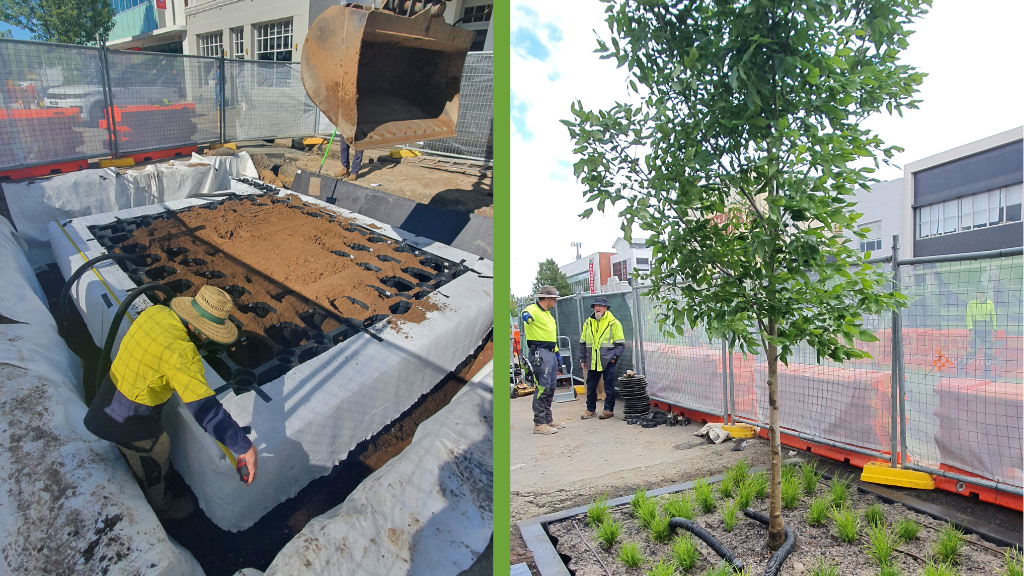
By creating space for adequate aeration with the Stratavault, you can limit excessive soil compression, and the perforated pipes provide airflow and enable water to be piped directly into the roots.
Combining systems like these in urban areas with permeable pavements, and connecting roof water systems to tree pits helps harvest stormwater, better managing both tree watering needs and stormwater management. To find out more about watering and aerating tree pits to improve growth outcomes, head to https://citygreen.com/product-category/tree-pit-irrigation-and-aeration/
Posted by Ben Gooden on Thu, Jul 30, 2020 @ 3:29 AM
Lockdown. A time when many of us became all too familiar with our own homes. With restrictions easing in many parts of the world, many cities are re-evaluating what public space looks like.
One measure gaining traction with many businesses and local councils is the encouragement of alfresco dining and drinking. The Clematis Streetscape Project, currently in its final stage, saw one of the most iconic streets in West Palm Beach undergo significant changes, creating a more welcoming, comfortable outdoor experience.
(You can find out more about that project, which Citygreen were proud to be involved with here – Clematis Street case study)
Liverpool is another city looking to create green spaces which spread people out and improve social distancing, without resorting to bright yellow and orange ‘caution’ tape.
Their outdoor dining initiative is designed to give the city’s restaurants a much-needed boost and involves pedestrianizing several streets completely and introducing “parklets”.
According to design consultancy Meristem, parklets are a way of converting parking spaces into something far more welcoming than the typical park bench, with seating, plants, green walls, and shade trees. Where before, parking availability was a primary concern, the focus is now on creating spaces that welcome people.
Meristem director Habib Khan said, “research shows that the majority of money spent in businesses on High Streets and in cities is not from drivers anymore.” Parklets and similar spaces are a critical component of creating safe, inviting outdoor dining environments and helping businesses emerge from their coronavirus lockdown.
The use of plants and trees to provide shade and tranquillity in busy city hubs is vital, and Liverpool has even included transparent screens in parklet designs so that people can be together, but be assured in their own bubble.
And while 2016 saw office spaces everywhere looking at including green walls in their building, bringing the outdoors inside, 2020 might see the world flip the switch on that concept. With more cities looking to increase alfresco dining options, green walls and parklets might see more of our indoors showing up outside.
Citygreen is supportive of any idea that transforms grey spaces into green and helps cities and industries thrive in a post lockdown world. To find out more about our Green Wall solutions, head to https://citygreen.com/product-category/green-wall-systems/
Posted by Ben Gooden on Tue, May 28, 2019 @ 7:06 AM
To grow large trees in urban environments presents unique challenges and considerations. Urban settings often have limited space, compacted soil, and various infrastructure constraints that hinder tree growth. However, finding effective methods for nurturing substantial trees in cities is crucial for enhancing green spaces, improving air quality, and promoting overall health and well-being for urban dwellers.
Why We Need Larger Trees in Urban Environments
From combating air pollution and mitigating the urban heat island effect to fostering biodiversity and improving physical and mental well-being, larger trees play a crucial role in enhancing the overall quality of life.
Large Trees Mitigate the Urban Heat Island Effect
Strategic placement of trees in urban areas has been proven to have a remarkable cooling effect on the shaded regions, with temperature reductions ranging between 2ºC and 8ºC. This cooling phenomenon is a result of multiple interconnected factors.
Firstly, trees provide shade through their expansive canopies, which obstruct direct sunlight from reaching the ground. By blocking the sun’s rays, trees create a cooler microclimate beneath their canopy, shielding the area from excessive heat. This is especially beneficial in densely built urban environments, where concrete and asphalt tend to absorb and radiate heat, contributing to the urban heat island effect.
Secondly, through a process called transpiration, trees release water vapor into the atmosphere. This evapotranspiration process helps dissipate heat and lowers the air temperature, further contributing to the cooling effect in the shaded areas. In addition, as water vapor is released, it can also contribute to increasing local humidity, which enhances the comfort of the surroundings.
Large Trees are Great Urban Air Filters
Large urban trees play a pivotal role in mitigating environmental pollution and enhancing air quality in urban areas. As natural filters, they possess the remarkable capacity to absorb significant amounts of air and soil pollutants, including up to 150kg of carbon dioxide (CO2), along with fine particulates
The absorption of carbon dioxide by urban trees is a crucial process in combating the escalating issue of climate change. This carbon sequestration not only helps mitigate climate change but also aids in offsetting the carbon footprint of urbanized regions, contributing to broader efforts in achieving carbon neutrality and sustainability.
The effectiveness of urban trees as pollutant filter is influenced by their proximity to emission sources. Studies have shown that trees in close proximity to pollutant-emitting activities absorb up to nine times more pollutants than trees situated farther away. So, strategic tree planting near busy roads, industrial areas, and other pollution hotspots is essential to maximize their air purification capabilities and create healthier living spaces.
The presence of large trees in urban landscapes has far-reaching effects on water bodies and the ecosystems they support.
One of the key contributions of large trees in urban settings lies in their capacity to manage and clean stormwater runoff. Impermeable surfaces like roads, pavements, and rooftops prevent rainwater from naturally infiltrating the soil. As a result, large volumes of stormwater rush over these surfaces, picking up pollutants such as oil, heavy metals, fertilizers, and other contaminants.
See how Citygreen integrate trees into the Stormwater Management process with our Strataflow System.
Large trees provide a host of physical and mental health benefits. Their presence in urban environments not only fosters cleaner air but also encourages higher levels of outdoor physical activity among nearby residents, as they create a cooler and more inviting environment for exercise
On the mental health front, spending time in the presence of large trees has been linked to reduced stress and anxiety levels. Being in nature and experiencing green spaces have a calming effect on the mind, promoting relaxation and mental rejuvenation. Moreover, large trees create aesthetically pleasing environments that positively influence mood and emotional states.
Larger Trees Improve Property Values
Larger trees significantly contribute to improving property values and are regarded as valuable assets in real estate and urban planning. The presence of well-established trees in residential neighborhoods and commercial areas adds a touch of natural beauty, reduce noise pollution, decrease crime rates, and reduce power usage due to temperate reductions. Another study also showed that, for every dollar invested in planting, cities see an average US$2.25 return on their investment each year.
So, the faster tree canopies grow, the sooner the benefits can be enjoyed by cities, stakeholders and communities.
How to Plant Large Trees in an Urban Environment
Planting large trees in an urban environment requires careful planning and the implementation of effective strategies to ensure the successful establishment and long-term growth of the tree. Utilizing advanced urban forestry practices and harnessing the potential of technology like Citygreen’s Stratavault soil vault system can significantly enhance the viability and sustainability of urban tree planting.
Another crucial aspect is the preparation of the planting site. Urban soils are often highly compacted due to the need to support surround infrastructure such as pavement, roads and building foundation. Highly compacted soil is not conducive to tree growth as the soil is and lacking in nutrients, oxygen and space for growth which hinders root development .
When growing large trees in urban environments, Citygreen’s Stratavault soil vault product proves to be a game-changer when it comes to urban tree planting. Its modular design allows for efficient and scalable tree planting in confined urban spaces. The stratavault system creates an ample underground soil volume, providing ample room for root expansion and nutrient uptake while ensuring the roots are contained within the matrix and never impact surrounding infrastructure like roads pavements, and underground utilities. This innovative technology also facilitates stormwater management, reducing runoff, stormwater capture and storage while enhancing the tree’s access to water, ensuring its resilience during dry periods.
Another consideration when planting large trees in urban areas is the selection of suitable tree species. Opting for native or adaptive tree species that are well-suited to the local climate, soil conditions, and urban challenges is crucial. These species exhibit greater resilience to local environmental stressors, making them more likely to thrive in the often harsh urban settings.
Urban Tree Growth Case Study
At Citygreen, we love science. Since 2011, we’ve researched, developed and refined our range of sustainable urban landscape solutions to withstand rigorous testing – and produce outstanding results. So, when our Stratacell structural soil vault system became the subject of a study comparing the performance of soil treatments under concrete paving, we were keen to see the findings.
The study, entitled ‘Comparison of Soil Treatments Under Concrete Pavement’ was conducted by Thomas Smiley, James Urban and Kelby Fite at the Bartlett Tree Research Laboratory in Charlotte, North Carolina. It examined variations of the two main approaches that have been developed to provide rooting space for trees in urban areas – supported pavement and structural growing media.
Overall, the study found that structural https://citygreen.com/understanding-the-importance-of-tree-canopy/load bearing modules (like Citygreen Stratacell and Stratavault systems) grow the largest, healthiest trees in the fastest time. It also highlighted the superior all-round performance of these systems compared to others.
Study goals
The purpose of the study was to compare the growth of trees in different supported pavements and structural growing media. The aim was to determine which methodology would produce the largest, healthiest trees in the shortest time.
Combats climate change by reducing greenhouse gas emissions
Provides natural shade and cooling
Conserves energy and reduces power costs
Enables water filtration and retention
Provides habitats for wildlife
Increases property and area values
Promotes health and wellbeing
Contributes to a sense of place
Encourages community interactions
SUP Trial Plot Sept 2017
Methodology
To achieve the study goals, two plots were established at the Bartlett Tree Research Laboratory. The first plot was installed in 2004, exclusively for Study 1, which examined five variations of supported pavement systems. The second plot was established in 2014, specifically for Study 2, which examined six variations of structural media.
Citygreen’s Stratacell system was part of Study 2, which also included an open control, compacted control, sand based structural soil (SBSS), gravel based structural soil (GBSS) and another structural load bearing module, similar to Stratacell.
At the start of Study 2, on 19 August 2014, containerised 18mm caliper Liriodendron chinense trees were installed in the centre of each plot. A 5cm thick layer of concrete was poured over the plot, with a 20cm hole centred on each tree. A soil moisture sensor was also fitted.
Over the following three years, the trees were measured and assessed regularly against key performance indicators. On 23 October 2017, the trees were severed at the root for final measurements and findings. During the excavation, soil was removed from the roots, leaving the mass intact for examination.
Pressure wash and Hydrovac for removal of soil from the root systems
Airspade removing soil from around the roots
Weighing Process of all root systems
How to Grow Large Trees in Urban Environments Key Findings
Overall, the study found that soil treatments that provided a low density growing media aka uncompacted soil (such as Citygreen Stratacell and Stratavault) resulted in the largest, healthiest trees in the shortest time. These findings were consistent across Study 1 and Study 2. However, in Study 2, the tree growth differences between the systems were more pronounced than in Study 1.
The structural load bearing systems, including Stratacell, performed extremely well in Study 2. Compared to the compacted soil, SBSS and GBSS, these systems consistently achieved the highest scores across multiple measures of tree health and growth, including:
Tree trunk diameter
Tree height
Foliar Colour
Number of roots > 1.2cm diameter
Maximum root spread
Maximum root depth
Weight of tree parts
Moisture content of soil
Stratacell outperformed all other systems in terms of maximum root depth, moisture content and foliar colour. Like the other structural load bearing module, it also produced significantly larger trees with more large roots than other treatments, including compacted soil, SBSS and GBSS.
The final findings were consistent with observations throughout the study, which reported that the trees in structural load bearing modules began to diverge from other treatments by the end of 2015. Similarly, in 2016 and 2017, there were significantly larger than most other treatments.
Trees grown in structural load bearing modules
Tree roots developed in Stratacell and Silvacell vault systems
Root systems grown in gravel based Structural Soil
Green space for shading and mitigation of heat island effect
Providing soil volumes in urban spaces
Conclusion
The study concluded that structural soil vault modules (such as Citygreen Stratacell and Stratavault) are superior for growing large, healthy trees in the fastest times when compared to other systems, such as compacted soil, SBSS and GBSS.
While the study did not point to a ‘best product’, it proved the methods that support the load on a pavement and keep that load off the growing media work better than those that don’t.
This is good news for urban planners, landscape gardeners, architects and developers. It means that, simply by choosing a structural load bearing soil system, they can achieve the canopy cover they require years sooner than they might with other systems.
Similarly, cities, communities and individuals can enjoy the environmental, economic and health benefits of tree canopies faster and for longer.
Have one of the Citygreen contact you.
Contact the friendly Citygreen Team now for more information by clicking here.
Download the full report
Click here to download the full ‘Comparisons of Soil Treatments Under Concrete Pavement’ study.
Posted by Ben Gooden on Mon, Jul 10, 2017 @ 5:05 AM
What are Soil Vaults and How Do they Benefit City Trees?
Soil vaults like Citygreen’s Stratavault are underground structures that provide a natural rooting environment for trees in urban areas where soil is often compacted to handle the stress and weight of the above urban infrastructure. They are a modular matrix designed to support all of the tree’s mineral, nutrient, and root spaces requirements ensuring ideal underground growth conditions, while taking the weight of the above infrastructure off from the tree.
Are Soil Vaults a Cost-Effective Solution for Urban Landscaping?”
Yes, soil vaults can be considered a cost-effective solution for urban landscaping in the long run. While the initial investment in installing soil vaults may be higher compared to traditional methods, their long-term benefits often outweigh the upfront costs.
Here’s why soil vaults can be cost-effective:
Reduced Tree Replacement Costs: Soil vaults provide an optimal environment for tree root growth, leading to healthier and more resilient trees. This reduces the need for frequent tree replacements, which can be expensive in terms of tree purchase, planting, and labor.
Enhanced Tree Growth: Soil vaults offer trees the necessary space, nutrients, and oxygen for robust growth. Well-established trees require less maintenance over time, leading to lower ongoing maintenance costs.
Prevention of Infrastructure Damage: Urban trees with strong root systems supported by soil vaults are less likely to disrupt sidewalks, roads, and other infrastructure, reducing the need for costly repairs.
Environmental Benefits: Healthy trees provide various environmental advantages, such as improved air quality, reduced energy costs through shading, and stormwater management. These benefits can lead to long-term savings for municipalities and property owners.
Increased Property Value: Green spaces and healthy trees contribute to the aesthetic appeal of urban areas, increasing property values and attracting businesses and residents. This positive economic impact can indirectly contribute to the cost-effectiveness of soil vaults.
While soil vaults may have higher initial installation costs, their ability to accelerate healthy tree growth, minimize maintenance, prevent infrastructure damage, and provide numerous environmental and economic benefits make them a viable long-term investment for urban landscaping projects, and this is where having a asset register of your trees is invaluable to seeing the lifetime value green infrastructure can have.
All city councils have an asset register detailing the value of assets like roads, parks, street furniture, and so on. Increasingly – and rightly so – trees are now being included as quantifiable assets. In the past, it has been hard to quantify the value of trees, but today there are a number of methodologies for doing so. One such method, the Burnley Method – developed by Dr Greg Moore at the Victorian College of Agriculture and Horticulture Limited, Burnley Campus – is now being widely used and accepted. Available for download here.
The Burnley Method For Valuing Trees
The Burnley Method is a way to determine the value of trees in a straightforward manner. It involves looking at different aspects of a tree, such as its type, size, health, and where it’s located. By considering these factors, we can figure out how valuable the tree is both in terms of its natural qualities and its surroundings. The Burnley Method helps provide a clear and organized approach to assessing the worth of trees.
Formula:
VALUE ($) = TREE VOLUME x BASE VALUE x (E) x (V) x (FV) x (L)
The modifiers to be used are:
TREE SIZE (V) : With large trees, the values determined by the formula were unrealistically high. Accordingly, a modifier was developed (Table 1) to reduce the value.
USEFUL LIFE EXPECTANCY (E) : This modifier took into account the projected useful life expectancy of the specimen (Table 2).
FORM AND VIGOUR (FV) : This factor was used to assess the form and vigour of the tree (Table 3)
LOCATION (L) : This modifier was used to assess the tree’s suitability for its particular location (Table 4).
The City of Melbourne are pioneers in valuing their trees and looking after them accordingly. In fact, residents can even email local trees to raise concerns about their health or express their appreciation and affection for the tree. By putting a value on trees, councils are able to protect them in new and quantifiable ways.
For example, if a developer is building near a valuable tree, the council may require them to pay a bond – refunded provided the tree is unharmed post construction. If a developer destroys or removes a tree without permission, the council is able to sue that developer for the value of the tree per their register. All of this is effective and much-needed motivation to keep our valuable urban trees safe.
A council’s asset register forms a key part of their balance sheet. As the assets degrade over time, there is depreciation. Spend money on their assets, and there is growth. Naturally, councils want to spend money wisely in order to generate the greatest return on investment.
In an asphalt carpark next to an oval, five London Plane trees were planted in quite narrow islands, with adequate space and soil volume provided using the Stratacell system beneath the carpark pavement. The cost for the five trees (including the Stratacell soil vault system) was $50,000 at time of initial planting.
Four years later, as reported by Council, the trees have grown at an unprecedented rate – from a 75mm/3” trunk diameter at time of planting, to 250mm/10”. According to the Burnley method, these trees are valued by Council at $17,500 each – an amazing return on investment in just four years, with so much growth (literally and financially) still to come.
As a comparison, the same council planted the same species 15 years ago in a nearby carpark using the conventional method. The carpark was laid, a square cut in the pavement, some curbing placed around the edges, road base dug out, and a 80/20 structural soil loaded into the hole.
Planted 15 years ago (versus only four), these trees are valued at only $510 each. Of course, the initial outlay was much less ($250 per tree), but the return on investment monetarily, aesthetically and environmentally does not compare.
Essentially, using the Citygreen soil vault system, this innovative Council was able to grow trees worth 34 times as much – in one quarter of the time!. As more emphasis is placed on generating ROI in relation to the value of trees, adopting innovative technology which enables trees to thrive in urban environments must be a priority.
Of course, this is not just about improving councils’ bottom lines, but also improving the health and wellbeing of the communities they serve.
Speak to our team to explore how soil vaults can maximise the value of your trees and generate an ROI faster.
As urbanization continues to reshape our landscapes, the concept of a Water Sensitive Urban Design (WSUD) has gained prominence as a holistic approach to address the challenges of water management in cities. Let’s look into the intricacies of WSUD, examining its principles, benefits, challenges, and implementation strategies.
Water Sensitive Urban Design (WSUD) is also known as Low Impact Development (LID) in the United States, and Sustainable Urban Drainage Systems (SUDS) in the United Kingdom.
It all refers to the land planning and engineering design approach that integrates the urban water cycle, including stormwater, groundwater, and wastewater management and water supply, into urban design. This is done to minimise the environmental degradation as well as improve the look of the area by creating a circular economy of urban water use.
In urban environments, impermeable surfaces like roads, roofs, driveways, and walkways prevent water from soaking into the ground, resulting in what we call stormwater runoff. Additionally, the presence of vehicles and industrial activities in these areas contributes to the accumulation of pollutants on these surfaces. When it rains, this polluted runoff is funneled through drains, eventually reaching creeks and rivers, causing pollution and degradation to environmentally crucial systems. Water-Sensitive Urban Design (WSUD) is a solution designed to enhance urban areas’ capacity to capture, treat, and recycle stormwater, preventing it from polluting and harming our natural waterways and ensuring rain water is used in the environment in which is falls more efficiently.
Why Use Water Sensitive Urban Design When Designing your Urban Environment?
According to the guidelines released by the South Eastern Councils in Melbourne Victoria, WSUD has been identified as a “means to control flows and filter stormwater to remove pollutants”.
Stormwater is the water that runs off urban surfaces after heavy rainfall. The report said it has been identified as the key cause of pollution and declining health of waterways.
“With increased urban development, the proportion of impervious surfaces in our catchments increases. This increases the velocity and amount of water running into our waterways, creating problems of erosion and flooding and changing natural flow regimes, with associated ecological damage. It also washes more pollutants into our streams, further impacting river health.”
Victoria councils, like other councils in Australia, have recognised the importance of sustainable water management such as WSUD. The release of various guidelines enables organisations to have a first point of reference for their projects.
The design “integrates urban water cycle management with urban planning and design, with the aim of mimicking natural systems to minimise negative impacts on the natural water cycle and receiving waterways and bays”.
Types of WSUD
Stormwater Treatment Element
Application
Litter/Organic Matter
Coarse Sediment
Fine Sediment
Total Phosphorus/Nitrogen Removed
Oil & Grease
Reduction in Runoff Volume
Construction
Maintenance
Vegetated Swales
Primary/Secondary
H
H
H
L
L
L
L
L
Bioretention Swales
Primary/Secondary/Tertiary (may need sediment and litter pre-filtering)
H
H
H
M
L
M
L
M
Bioretention Basins/Raingardens
Primary/Secondary/Tertiary (may need sediment and litter pre-filtering)
H
H
H
M
L
M
L
M
Sediment Basins
Primary, often combined with detention
M
H
M
L
L
L
L
M
Ponds/Wet Basins
Primary/Secondary/Tertiary
H
H
M
L
L
L
L
M
Constructed Wetlands
Secondary/Tertiary
–
–
H
H
L
M
L
H
Exfiltration Systems
Secondary (needs sediment and litter pre-filtering)
–
–
–
H
L
M
L
M
Soil Cells
Various (often combined with filtering and detention)
L
L
L
H
L
H
H
L
Soft vs Hard Engineering of Landscapes
Soft engineering and hard engineering are two approaches used in water management and urban design.
Soft Engineering: In the context of Water Sensitive Urban Design (WSUD), soft engineering refers to the use of natural or nature-based solutions to manage water, such as vegetation, soil, and natural drainage systems. Soft engineering aims to mimic natural processes and ecosystems to reduce runoff, improve water quality, and enhance the aesthetic and ecological value of the landscape. Examples of soft engineering in WSUD include bioretention swales, vegetated basins, soil cell tree pits, and constructed wetlands.
Hard Engineering: Hard engineering, on the other hand, involves the use of man-made or engineered structures to manage water, such as pipes, concrete channels, and traditional drainage systems. In the context of WSUD, hard engineering components may be necessary in situations where factors such as the need to transport water across paved areas, land availability, or topography require the use of piped or hard components. Examples of hard engineering in WSUD include piped drainage systems, concrete structures, and permeable hard surfaces such as rock rip-rap or paving.
WSUD elements are most effective when vegetation and trees are used in their design, factors such as the need for water to be transported across paved areas, land availability, and topography may require the incorporation of hard components into a broader WSUD system.
While there is no standard approach that should be applied to all situations, and a hybrid solution that combines both soft and hard engineering components may be necessary to address site-specific opportunities and constraints, Creating softscapes with increased greenery and trees will be a great economic, environmental and health impact to the local community.
Case Study
In places such as Canada, capturing stormwater is a mandatory requirement for all new constructions, as a means to effectively manage water and prevent a higher level of pollutants from entering municipalities.
In flat open areas such as carpark where pollutants and stormwater runoff can be a concern Citygreen’s Stratavault offers a cohesive solution that connects stormwater management with landscape tree design. Instead of stormwater immediately entering the city infrastructure and depleting the valuable water resource by taking it out of area, our integrated water sensitive urban design directs the stormwater into the Stratavault matrix.
This innovative system allows trees and soil to utilize the water for their own needs and growth while effectively cleaning the excess water of contaminants before the water enters the pit’s base chamber. Additionally, this design enables the recycling of water for on-site irrigation & a slower release back into the city’s infrastructure during periods of lower demand
What are the Key Principles of WSUD?
Some of the key principles of WSUD as stated in the Urban Stormwater: Best Practice Environmental Management Guidelines (BPEMG) include:
Protect and enhance natural water systems within urban environments.
Improve the quality of water draining from urban developments into receiving catchment environments.
Reduce runoff and peak flows from urban developments by increasing local detention times and minimising impervious areas.
Minimise drainage infrastructure costs of development due to reduced runoff and peak flows.
What are the Benefits of WSUD?
The top benefits of using water sensitive urban design include:
Flood Mitigation: By reducing stormwater runoff and increasing water infiltration, WSUD minimizes the risk of flooding during heavy rain events.
Improved Water Quality: Natural filtration methods used in WSUD systems effectively remove pollutants, enhancing the quality of water entering streams and rivers.
Urban Cooling: Urban green spaces and water features provide cooling effects, mitigating the urban heat island effect and improving overall urban livability.
Biodiversity Enhancement: WSUD encourages the creation of habitats for various species, contributing to urban biodiversity and ecosystem health.
Enhanced Tree Growth: By directing extra resources to nearby trees you give the tree more opportunity to successfully grow
Increased Social Outcomes: Improving the greenery, liveability, and functionality of shared urban spaces increases the the physical, social and mental health of the community.
What are the Challenges of WSUD?
Given that water-sensitive urban design is a relatively new concept within the realm of urban landscaping, there emerge several challenges in the process of designing new WSUD spaces. These include:
Regulatory Barriers: Traditional regulations and codes may not be aligned with WSUD principles. Overcoming regulatory hurdles and advocating for changes to local ordinances can be a significant challenge.
Lack of Awareness: Many stakeholders, including local governments, developers, and the general public, may be unaware of the benefits and importance of WSUD.
Funding Constraints: WSUD projects may require upfront investments for designing, construction, and maintenance. Convincing stakeholders to allocate budgets for these projects in the face of other competing priorities can be challenging.
Infrastructure Retrofitting: Integrating WSUD into existing urban areas often requires retrofitting existing infrastructure. This can be complex, costly, and disruptive to ongoing operations.
Maintenance and Long-Term Management: Proper maintenance of WSUD components is essential to their effectiveness. Ensuring consistent and appropriate maintenance practices can be challenging, especially if communities lack the necessary resources or knowledge.
Data Availability: Designing WSUD systems requires accurate and up-to-date data on rainfall patterns, land use, and hydrology. In some cases, obtaining this data may be a challenge, especially in areas with limited resources for data collection.
Interdisciplinary Collaboration: WSUD projects require collaboration among various disciplines, such as urban planning, landscape architecture, civil engineering, and environmental science. Coordinating and aligning efforts across these disciplines can be complex.
Resilience to Climate Change: WSUD systems must be designed to accommodate changing climate patterns, including more frequent and intense rainfall events. Ensuring the resilience of these systems can be a challenge.
Rainwater Runoff
Citygreen® products are designed to ensure it supports the effort for a sustainable water management. The Stratavault’s™ modules leave over 94 percent of its total volume for root growth and storm water harvesting. Find out more about the products here.
“Great customer service, quick response times and a very in depth QA system with constant support.”
- Laura Wiesenekker, Project Engineer, Densford Civil -
“Citygreen is a very professional business, and I found everything was great in terms of deliveries, product supply and information. It was all forthcoming and helped us to complete the project.”
- Keith Burns, Architect/Designer, Keith Burns Architect -
“Citygreen offered training and invaluable technical assistance during the works.”
- James Callan, Estimating Manager, Complex Co Pty Ltd -
“Our experience, in working with a Citygreen Design Studio was second to none. We found responses from the design studio to be very timely, and technically thorough. We went backwards and forwards a number of times, looking at different iterations of the design and, nothing was too much trouble to examine and explore different possibilities. I would highly recommend the Citygreen Design Studio to any future client considering using your services.”
- Sandra Smith, Principal Landscape Architect, City Of Monash -
“We are big on compliance on all projects, and the fact that their SmartCertify cloud platform covers all bases, and supports their 20 year warranties, is critical – especially that these pits are being installed under roadways and footpaths.”
- Johny Purkaystha, Civil Program Engineer, Central Coast Council -
"I reviewed all the previous projects that we have installed in the past couple years using your product and I can happily report back that we have 0% mortality in the soil cells, which is incredible!"
- Brendan Wilton, CEO, Trim Landscaping, Bedford, Canada -