Castlegar main corridor comes to life with 22 new trees Copy

Castlegar main corridor comes to life with 22 new trees

Castlegar located within the Selkirk Mountains of British Columbia, Canada, is home to a small but growing community. It is also a hub for regional trade and transportation. Castlegar is known for its vast forests. However, until recently, its streets were significantly lacking in trees.

In 2018, the City of Castlegar embarked on a master plan to add more trees to the main roads. Citygreen was engaged by Marwest Industries (on behalf of the City) to help bring this vision to life – efficiently, affordably and sustainably.

The project commenced in June 2018 on Columbia Avenue. Together with local contractors and trades, Citygreen’s urban landscape solutions have transformed this previously barren space into a vibrant city corridor.

Project goals

The City’s major goal for this project was to incorporate as many trees as possible into the Columbia Avenue corridor. As the only intown route between the uptown and downtown areas, this corridor attracts a high volume of road and foot traffic.

The City wanted to integrate urban trees into the landscape, creating a seamless aesthetic from the mountains to the streets, while also providing much-needed shade.

As Dean Thompson from Urban Systems explained, “It’s in quite a busy urban area. We wanted to make it feel continuous with the forest around us by bringing elements of the surrounding area out to the road.”

“We also wanted to provide shade and encourage people to spend time on the street. This is a pretty harsh corridor with lots of hard surfaces. So, providing a refuge and shade was an important goal for this project.”

Castlegar


Project challenges and solutions

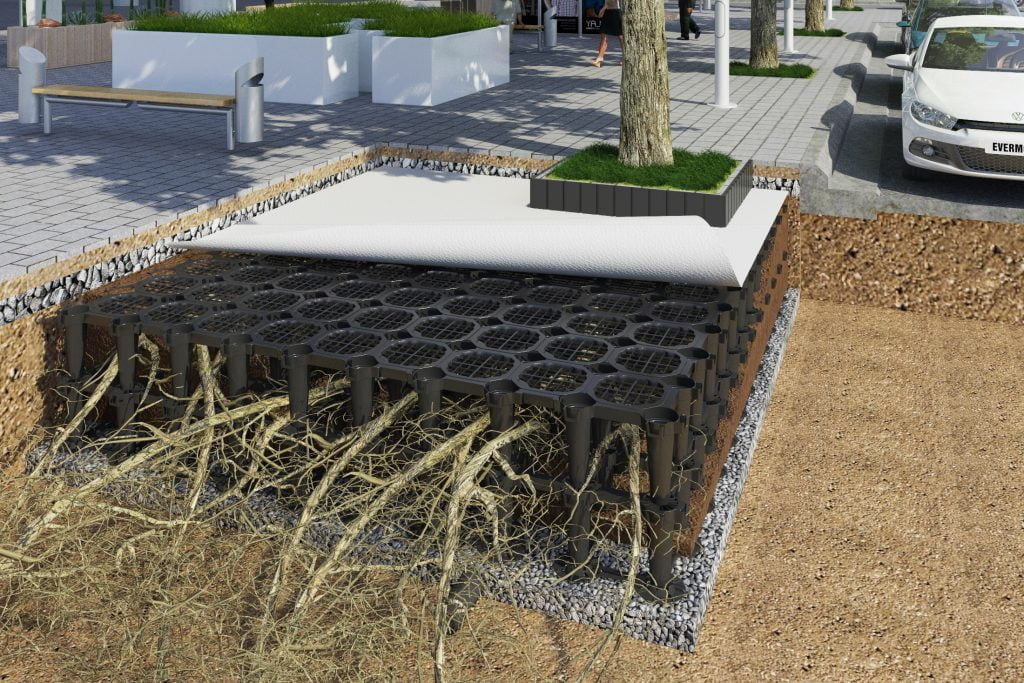
Stratavault was selected as the best solution for a number of reasons. Its ability to deliver maximum soil volume (over 94%) for healthy tree root growth, combined with its incredible strength, made it  ideal for this high traffic area.

“Uncompacted soil volume is very important for the success of these trees. Without it, they wouldn’t be given the proper nutrients or ability to grow, especially in such a harsh urban corridor like this,” said Dean.

“Stratavault is rated for the correct loading, so it was safe and reliable to install right under the heavy travel lanes, where we wouldn’t necessarily want structural soil,” he added.

Like all Citygreen solutions, Stratavault is made using 100% recycled polymers, providing maximum green building benefit. This, along with ease of installation and stormwater management benefits, added extra value to the project.

“The Stratavault soil cells have a small footprint and they are easy to install. They also integrate with stormwater distribution channels we have to provide water for the trees. This creates a healthier environment for the trees to thrive naturally,” said Dean

Elaborating on the water management benefits, Dean explained: “It’s great that we can incorporate rainwater into the soil cells for a number of reasons. One is that rainwater is a resource we can capture and use. Another is that the soil cells keep rainwater from running into the river, which is connected to a large catchment on site. Being able to keep less-than-ideal rainwater out of the river is fantastic.”

Castlegar

Project outcomes

The City’s project goals have been realised, with 22 healthy trees now installed along Castlegar’s main corridor. The combination of Oak Ash and Maple trees add shade and colour to the street, providing a pleasant experience for both pedestrians and drivers.

To further enhance the project, each tree is complemented by a unique piece of street furniture, which entices people to spend more time on the street.

In terms of Citygreen’s solutions, there’s been nothing but praise from project stakeholders, including Dean Thompson from Urban Systems.

“From an engineering standpoint, I felt very comfortable specifying Stratavault right next to the road, under the travel lanes. The load capacity is certified by a structural engineer as well as the Citygreen product sheets, and I wouldn’t hesitate to use Stratavault for future projects,” he said.

“We’re providing a healthy environment for the trees using a 100% recycled product that’s easy to install and integrates stormwater. I can certainly see an uptake of Stratavault in the next five years. There are no downsides to using this product.”

Want more trees for your next project? Talk to our team
The Top 5 Reasons Soil Quality Is Important For Trees

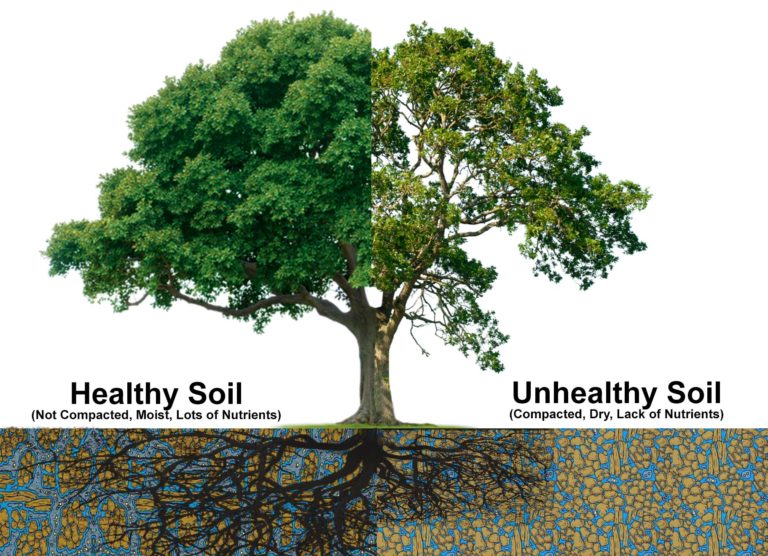
showing the difference in root growth in soil quality

Everybody knows that good soil quality is the foundation for tree growth!

However, not all soils are the same, and that can have a significant impact on the trees growing from it.

Cultivating the right kind of soil will ensure trees will live and thrive, even in urban locations where there is less room for them to survive.

That’s why it’s so important to take note on what’s happening below ground, if you want to enjoy the beauty and shade of the greenery above.

Let’s take a closer look at soil and its importance for healthy tree growth.

soil profile soil quality Citygreen

What Makes Up Good Soil Quality?

Soil is composed mainly of elements like water, minerals, nutrients and gases.

Different types of soil vary according to texture, colour, depth, acidity, fertility and ability to hold water. Because each tree species has different needs, it’s crucial to know what kind of soil they require to grow – if you want the best results.

To help familiarise yourself with the varieties of soil, here are the most common types of soils you need to remember:

  • Chalky – a stony type of soil that can be found on top of limestone or bedrock
  • Clay – a tightly packed soil that is often lumpy and sticky when wet
  • Sandy – dry and loose soil base that has a rough texture
  • Silt – smooth, slippery kind of soil that is composed of fine particles
  • Peaty – contains a great amount of organic matter due to its acidic nature
  • Loamy – the best soil for planting, as it’s full of nutrients and can hold water well
CITYGREEN Tree Visual vector1 soil quality Citygreen

Why is Loamy Soil the Best?

Loamy soil stands out as an optimal choice for trees due to its unique blend of qualities that foster robust growth. Its balanced composition—a blend of sand, silt, and clay—provides an uncompacted environment for tree roots. Loamy soil offers excellent drainage, preventing waterlogging that can drown roots, while retaining enough moisture to sustain trees during dry spells. Moreover, loamy soil is rich in essential nutrients, supporting healthy tree development by efficiently absorbing and storing vital minerals. Its texture facilitates superior aeration, preventing compaction and enabling roots to spread easily, reducing the amount of energy the tree needs to use to push new root growth through the soil ensuring strong anchorage and encouraging healthy root systems. The versatility of loamy soil accommodates a wide variety of tree species, making it an excellent choice for nurturing flourishing trees.

However, while loamy soil is generally advantageous for tree growth, different tree species may have specific soil preferences. Factors like climate conditions, sunlight exposure, and adequate care significantly impact a tree’s health and growth.

At Citygreen we do on-site soil analysis for any new plantings and can offer you soil specifically designed for the tree and site location. This ensures that the tree is planted in the best possible circumstances to kickstart canopy growth.

soil cell being filled with high quality loamy soil

Why is Soil Quality Important for Tree Health?

The soil you use can either nurture or restrain your trees’ growth because soil performs a lot of essential functions. Here are the five reasons why soil is important for trees:

Soil provides a foundation for tree growth.

Soil serves as the anchor that holds trees firmly in place. It provides structural stability, preventing them from toppling over in adverse weather conditions. The composition and texture of the soil determine how well it can support a tree’s weight and ensure it remains upright throughout its life.

Soil stores the necessary amount of water for trees.

Soil acts as a reservoir for water, which is crucial for a tree’s survival and growth. It stores rainwater and moisture, making it available to tree roots during dry periods. This stored water ensures that trees can continue photosynthesis and nutrient uptake even when external water sources are scarce.

Soil Hosts Biodiversity.

Soil is a vibrant ecosystem teeming with life. It provides habitat for various organisms, from earthworms to beneficial microorganisms. This biodiversity is essential for soil health and indirectly benefits trees by enhancing nutrient cycling, improving soil structure, and promoting overall soil vitality.

Soil supports the trees’ roots in accessing nutrients and minerals.

The root system of a tree relies on the soil to access essential nutrients and minerals. These nutrients are found in the soil in various forms, and the tree’s roots play a vital role in absorbing and transporting them to different parts of the tree. Adequate soil composition is crucial to ensure that trees receive the nutrients they need to grow and thrive.

Soil filters out the pollutants that can harm trees.

Soil serves as a natural filter, removing harmful pollutants from water before it reaches a tree’s root system. Pollutants, such as heavy metals or chemicals, can be detrimental to trees if they enter their vascular system. The soil acts as a protective barrier, purifying water and ensuring that only clean, nutrient-rich water is available to the tree’s roots.

strataflow system showing how stormwater can be used to filter and clean water

In urban locations where healthy soil is not abundant or tightly compacted to ensure stability for urban infrastructure, it’s important to ensure that trees are planted with the appropriate soil structure to compensate – often called the “architecture of the soil.”

Having the right soil architecture guarantees that there is proper arrangement of soil particles (including silt, sand and clay that aggregate together). It also involves measuring the correct pore spaces between each tree, which enables their roots to propagate without causing any structural pavement damage.

When these two considerations are overlooked, trees will struggle to grow in city and suburban locations, leading to replacement and maintenance costs, unsightly spaces and poor shade quality for the community.

Citygreen understands this challenge.

That’s why we deliver innovative urban landscape solutions like Soil Vault Systems. Our very own Stratavault© and Stratacell© tree products facilitate healthy root growth for your trees while making sure they won’t cause any damage to your city’s infrastructure.

To find out more about these products, head to https://citygreen.com/product-category/soil-structure-systems/.

Visual 6 1 Stratavault with Roots e1601433191112 soil quality Citygreen

Water Starved Tree

Quality soil and using it to fill the matrix

How To Properly Water Your Trees

dimitry anikin 77 IIuQptjY unsplash soil quality Citygreen

While people are supposed to drink about eight glasses of water a day, a tree in Ohio with a 10’ canopy can require as much as 100 gallons a day!

There are a couple of crucial considerations you need to take when it comes to water your trees. Insufficient water can lead to poor outcomes, including killing the tree. Too much water without sufficient aeration and drainage can have the same result.

A quick, easy way to test is to use a screwdriver to get about 2 – 3 inches down into the soil. If that soil feels moist to the touch, it’s exactly how it should be. If it’s dry, then it’s time to water.

Watering a young tree (<25 years old) is a matter of watering the roots around the trunk. You don’t want to flood the tree trunk, nor do you want to water outside the root ball.

Older trees (>25 years or a trunk over 12” in diameter) require deep watering completed occasionally. You’re looking at about 10 gallons per 1” of trunk diameter per week during dry conditions.

So how do you get that water to your trees, without standing around with a hose all day?

There is a range of solutions, from slow-release water bags, bubbler hoses, and overhead irrigation systems, through to a 5-gallon bucket with holes drilled in the base.

Citygreen has shown exceptional outcomes with the healthy and fast growth of trees by combining soil vault systems, such as Stratavault, with perforated flexible piping systems around the root ball, for example, the Snorkil products.

By creating space for adequate aeration with the Stratavault, you can limit excessive soil compression, and the perforated pipes provide airflow and enable water to be piped directly into the roots.

Combining systems like these in urban areas with permeable pavements, and connecting roof water systems to tree pits helps harvest stormwater, better managing both tree watering needs and stormwater management. To find out more about watering and aerating tree pits to improve growth outcomes, head to https://citygreen.com/product-category/tree-pit-irrigation-and-aeration/

fran HdtcZUI3Qvk unsplash soil quality Citygreen celine lityo Cv8PE0fW5zA unsplash soil quality Citygreen

How Will Cities Change Post Lockdown?

gabe pierce 4Krye8cFYd4 unsplash soil quality Citygreen

Lockdown. A time when many of us became all too familiar with our own homes. With restrictions easing in many parts of the world, many cities are re-evaluating what public space looks like.

One measure gaining traction with many businesses and local councils is the encouragement of alfresco dining and drinking. The Clematis Streetscape Project, currently in its final stage, saw one of the most iconic streets in West Palm Beach undergo significant changes, creating a more welcoming, comfortable outdoor experience.

(You can find out more about that project, which Citygreen were proud to be involved with here – Clematis Street case study)

Liverpool is another city looking to create green spaces which spread people out and improve social distancing, without resorting to bright yellow and orange ‘caution’ tape.

Their outdoor dining initiative is designed to give the city’s restaurants a much-needed boost and involves pedestrianizing several streets completely and introducing “parklets”.

According to design consultancy Meristem, parklets are a way of converting parking spaces into something far more welcoming than the typical park bench, with seating, plants, green walls, and shade trees. Where before, parking availability was a primary concern, the focus is now on creating spaces that welcome people.

Meristem director Habib Khan said, “research shows that the majority of money spent in businesses on High Streets and in cities is not from drivers anymore.” Parklets and similar spaces are a critical component of creating safe, inviting outdoor dining environments and helping businesses emerge from their coronavirus lockdown.

The use of plants and trees to provide shade and tranquillity in busy city hubs is vital, and Liverpool has even included transparent screens in parklet designs so that people can be together, but be assured in their own bubble.

And while 2016 saw office spaces everywhere looking at including green walls in their building, bringing the outdoors inside, 2020 might see the world flip the switch on that concept. With more cities looking to increase alfresco dining options, green walls and parklets might see more of our indoors showing up outside.

Citygreen is supportive of any idea that transforms grey spaces into green and helps cities and industries thrive in a post lockdown world. To find out more about our Green Wall solutions, head to https://citygreen.com/product-category/green-wall-systems/

West Palm Beach Hub Streetscape Project

Award-winning project breathes new life into one of West Palm Beach’s most beloved streets.

Clematis Street 1 soil quality Citygreen

The Clematis Streetscape Project in West Palm beach aims to produce a quality public space that contributes to people’s health, happiness, and wellbeing in a busy downtown.

Clematis Street has been the hub of West Palm Beach since 1894, evolving for over a century to embrace nearly every significant architectural era in that time but, despite a new passenger rail station just steps away, the lack of shade and narrow sidewalks had been dampening the success of retail, restaurants, and commercial tenants. With Phase 1 completed and Phase 2 underway, the Project was the People’s Choice Award Winner at the 2019 Safe Streets Summit. Now, with Phase 3 due for completion in 2020, the “living room” of West Palm Beach has a future every bit as incredible as its rich history.

Download Case Study Report


Clematis Street image

Photo Courtesy of Kimley-Horn and Associates, Inc. / C.J. Walker Photography™

Narrow sidewalks and lack of shade was dampening the success of retailers and restaurants, which made this a high-profile project that had to deliver a space that welcomed people in and made the street more walkable and popular. The Clematis Streetscape Project is a 3-phase approach to improving the historic Clematis Street with a desire to better connect the community by creating a more enjoyable downtown hub for locals and the 80,000 plus visitors who flock to the street every week. Initially, Phase 1 of the project was completed using an alternative solution to support the now-iconic oaks, but after Burkhardt Construction, Inc., the contractor for the project, suggested the change the decision was made to use the Stratavault product for Phase 2 and to continue with it for Phase 3.

west palm beach stratavault upgrade example

Photo Courtesy of Kimley-Horn and Associates, Inc. / C.J. Walker Photography™


Jonathan Haigh, Landscape Architect with project engineers Kimley-Horn, spoke to Citygreen about the project and the decision to change to the Stratavault product for the remainder of the project. The simplicity of Stratavault assembly and installation lead to the contractor recommending a change.

“There were challenges associated with the competing product as far as its assembly goes. The Stratavault system was easier for Burkhardt Construction, Inc. (contractor for the project) to work with and install in comparison to products we used prior. We were introduced to Citygreen by the contractors. He offered suggestions to help make things more efficient and save money,so we worked together with him to help deliver a quality project to the city.” – Jonathan Haigh, Landscape Architect

Stratavault has been designed to achieve major reductions in installation costs, with the units simply snapping together. Without the need for zip ties, screws, or ground spikes it can be assembled on-site in about 2 minutes per m3 (35 ft3).

Stratavault

Changes had to be made to deal with stormwater effectively. The change to Stratavault also helped with another element of the project as the iconic stretch was converted from a curbed, asphalt street to a curbless street with extensive use of pavers. This meant changes had to be made to deal with stormwater effectively.

“Stormwater, because it’s a curbless street now, we added more inlets in the street and the parking strip has permeable pavers that sit on top of portions of the Stratavault system. This helps to get water down into the roots and into the trees.” – Jonathan Haigh, Landscape Architect

Stratavault was used for live oak trees which were around 25 to 30 feet tall, field cut trees. With extensive paving usage, the risk of tree failure due to insufficient soil volume, aeration, or poor drainage ordinarily present in urban projects was mitigated by the Stratavault system.

705224415 960x540 1 soil quality Citygreen

The large oak trees have already proven their importance as West Palm Beach responded to COVID-19 related restrictions by moving their dining out to the streets.

“Everyone’s happy with the project itself. I mean, the fact that there’s more pedestrian space has been great. The fact that in these days, especially with the Coronavirus affecting a lot of Florida and outdoor dining becoming more common because of that, because of this project, we were able to increase the outdoor dining space on the street by quite a bit, because we eliminated some parking spaces, added the nice tree cover, shade trees and added that curbless street to make it flexible as well.” – Jonathan Haigh, Landscape Architect

With Stratavault giving the shade trees the best conditions to thrive, the shady, pedestrian-focused facelift has already improved customer foot traffic and patronage, making the most of the beautiful outdoor lifestyle Florida offers. As the project nears completion in 2020, the historic Clematis Street is ready to be part of the next century of West Palm Beach history.

Need more Trees for your project? Reach out to our Citygreen PROJECTS team!


Plans for Abu Dhabi’s first urban forest revealed

agnieszka m uOMQVDgzV6s unsplash soil quality Citygreen

Plans for the first urban forest in Abu Dhabi have been revealed as part of efforts to help residents connect with nature. Al Reem Island will be the site of a sprawling forest, The Reem Forest, one of hundreds intended to make the capital more liveable.

The forest will be a significant departure from the manicured lawns and carefully positioned palm trees that epitomize green spaces in Abu Dhabi. A self-sustaining wild forest, local trees that grow naturally in the Emirates will be used to minimise maintenance and achieve genuine biodiversity.

Rasmus Astrup, of Copenhagen-based architecture and landscape company SLA, said “For people who walk inside there is a forest track – it’s something that is a little inconvenient, a little dangerous, you have to walk on stepping stones in there. We want people to engage as much as possible with the nature. Of course, it’s not a forest like where I come from in Denmark. We have snow right now so it’s different. But it will have the feeling you get of being in a forest. There are no lawns, it is a park without any lawns. So it’s very different to what people are used to. We’re using only local species. Obviously it’s going to be interesting how people react to it.”

Andrew Grant, of UK-based landscape architect firm Grant Associates welcomed the initiative, saying, “There has to be a fundamental new way of thinking about landscapes in Abu Dhabi. I think Abu Dhabi has the opportunity, if they go with this in a really fundamental way, to really put a global exemplar out there to show how we can make our cities much more beautiful, nature-filled and attractive to live in.”

Source: https://www.thenational.ae/uae/environment/plans-unveiled-for-abu-dhabi-s-first-urban-forest-1.978899

More green space, more sleep? The research says yes

jordan whitt EerxztHCjM8 unsplash soil quality Citygreen

About 12-19% of adults in Australia don’t get enough sleep, defined as less than 5.5-6 hours each night. But who’d have thought that the amount of tree cover in their neighbourhood could be a factor? The latest research has found exactly that, with people who live surrounded by ample green space much more likely to get enough sleep than people in areas with less greenery.

Why is this the case? Hypotheses suggest that green space might counter the impacts of noise and air pollution and cool local heat islands, all of which make sleep difficult. These benefits are especially important in disadvantaged communities where many households might not have air conditioning and underlying health conditions can increase vulnerability.

We know too that contact with nature provides opportunities for psychological restoration and stress reduction. The benefits are greatest if there’s more tree canopy and more biodiversity – such as a richer variety of birdlife. Since early results provided evidence of a link between green space and sleep duration in Australia, many more studies from various countries have reported similar results.

As well as providing adequate urban green space, we need to encourage people to use it in order to experience the many health benefits. Nature-based interventions that enable people to regularly spend more time in urban parks and woodlands are increasingly important as we become more and more dependent on technology. For now though, get out in the garden, take a restorative stroll through your local park or enjoy a picnic in a botanic garden… and improve your chances of a good night’s sleep!

Source: https://theconversation.com/more-green-more-zzzzz-trees-may-help-us-sleep-132354


Younger Trees Outperforming Older Trees with Stratavault on Bulcock Street

Trees Planted with Stratavault Clearly Outperforming those Planted without

Bulcock St by Saturate 20 soil quality Citygreen

In 1917, Bulcock Street was established as the main street of sunny Caloundra on the Sunshine Coast. One hundred years later, competing against new urban centres, big box malls and online retail, the rundown street was in decline. In a $12 million four-stage project, Sunshine Coast Council (SCC) transformed the tired main street into a vibrant and liveable community space through the Bulcock Street Revitalisation Project. This project is Australia’s first smart city streetscape demonstration and testing facility, showcasing the latest smart city technologies.

download case study

Bulcock St by Saturate 12 soil quality Citygreen

Sian Crawford, Landscape Architect at SCC, said, “With the Sunshine Coast Council’s Landscape Architects acting in many roles; the client, the project manager, design lead, and project delivery, our challenge was to take the community and organisation on a journey to re-imagine the high street experience through a holistic place-making framework. As Landscape Architects, we listened, learned and shaped the streets cape forms, layout, infrastructure, selected materials and plants species, and collaborated with engineers and artists, as key participants in this process of collective leadership.”


Stratavault

Scott Howarth, Landscape Architect at SCC, said, “The design responded to the community’s desire for a green street with substantial tree planting and garden areas. To ensure success we instigated investment in underground tree health using Citygreen’s Stratavault system, specialist soil mixes and tree grow-on contracts. Between 2016 and 2018, 35 Elaeocarpus Obovatus were installed in the Stratavault system. These trees were 700L when installed and were grown by council’s nursery specifically for this is project.”

In total, the project saw a total of 105 extra trees planted in the street, though not all were installed in the Stratavault system. A few years down the track, this has provided an insightful comparison – with trees planted in stages 3 & 4 using Stratavault clearly outperforming those planted in stage 1 that didn’t use any type of Stratavault or Strata-cell system.

705224415 960x540 1 soil quality Citygreen

Sian Crawford said, “Feedback from the community has been overwhelmingly positive. In terms of the physical outcome, Bulcock Street is now a vibrantly-green, comfortable place to be. Momentum following the streets cape has resulted in a community embracing innovation and activation, with an increased sense of identity and self-determination. Eclectic in character, fun and colourful, the street has evolved into an ‘alternative’ retail experience that appeals to all ages and is uniquely ‘Caloundra’. Retail outcomes support this, with Caloundra experiencing an increase in the total spending during the 2017/18 financial year of 8% above the 2016/17 results (equating to $39.3 million in extra trade). An overwhelming success, the project was nominated for the 2020 Queensland AILA Landscape Architecture Awards.”

Images below show the results from Council’s initial trial – where the same species trees were planted at the same time, in the same street – with Citygreen structural vault system (on the right), and with rock-soil ‘structural soil’ mix, on the left.

bulcock 3 soil quality Citygreen


Load More...

“Great customer service, quick response times and a very in depth QA system with constant support.”

- Laura Wiesenekker, Project Engineer, Densford Civil -

“Citygreen is a very professional  business, and I found everything was great in terms of deliveries, product supply and information. It was all forthcoming and helped us to complete the project.”

- Keith Burns, Architect/Designer, Keith Burns Architect -

“Citygreen offered training and invaluable technical assistance during the works.”

- James Callan, Estimating Manager, Complex Co Pty Ltd -

“Our experience, in working with a Citygreen Design Studio was second to none. We found responses from the design studio to be very timely, and technically thorough. We went backwards and forwards a number of times, looking at different iterations of the design and, nothing was too much trouble to examine and explore different possibilities. I would highly recommend the Citygreen Design Studio to any future client considering using your services.”

- Sandra Smith, Principal Landscape Architect, City Of Monash -

“We are big on compliance on all projects, and the fact that their SmartCertify cloud platform covers all bases, and supports their 20 year warranties, is critical – especially that these pits are being installed under roadways and footpaths.”

- Johny Purkaystha, Civil Program Engineer, Central Coast Council -

"I reviewed all the previous projects that we have installed in the past couple years using your product and I can happily report back that we have 0% mortality in the soil cells, which is incredible!"

- Brendan Wilton, CEO, Trim Landscaping, Bedford, Canada -